



 +33 4 78 55 45 69
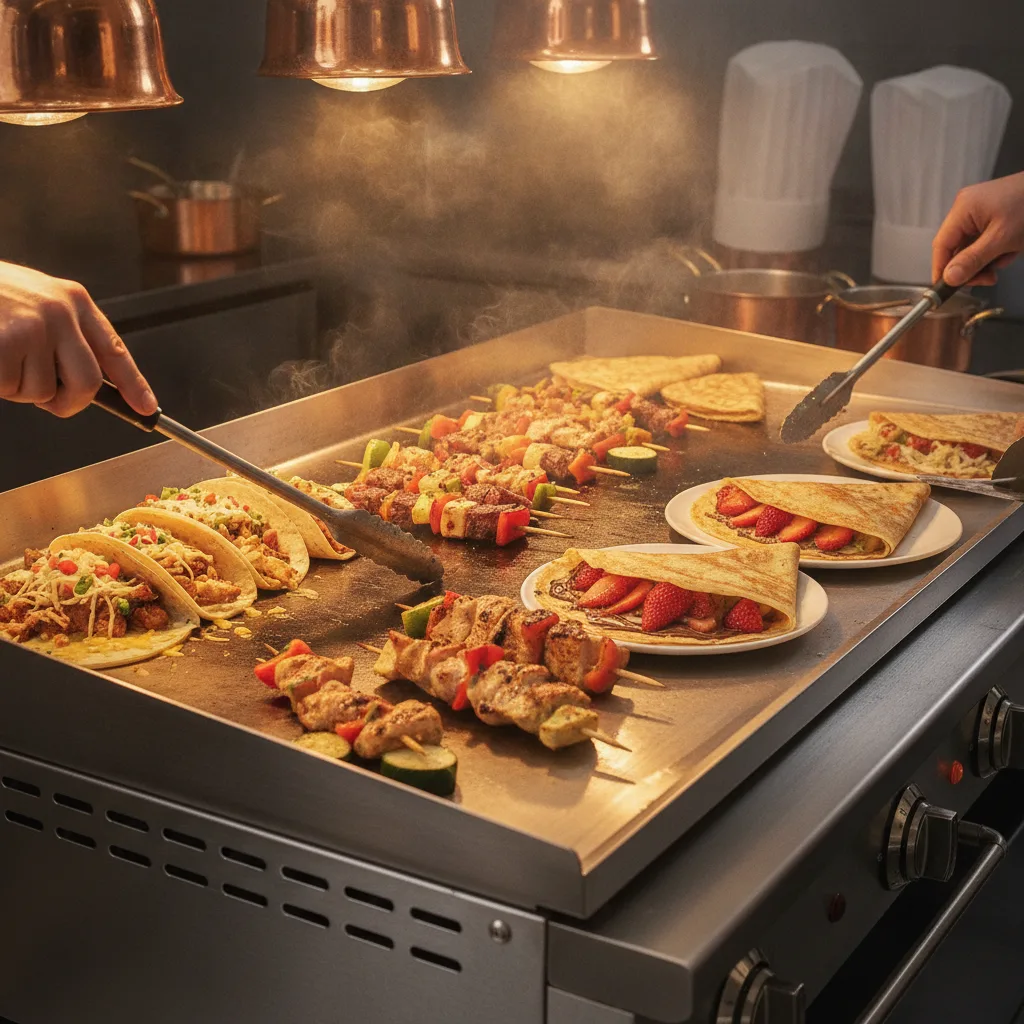
The best snacks in the world do not come out of an oven: they are born on a scorching plate, in direct contact with steel. That is exactly what a stainless steel electric plancha reproduces. Ideal for street food, it can recreate at home the techniques of the street kitchens of Osaka, Mexico City, Delhi or Caracas.
In this guide, we offer 10 plancha street food ideas from all corners of the globe, with plate temperatures, preheating times and the cooking order to follow. The aim is simple: replace the street grill with your stainless steel plate, with no black smoke and no professional equipment.
Plancha Street Food: 10 Snack Recipes from Around the World 2027
Reading time: ~9 min
- Why the plancha replaces the street grill
- Preheating and plate temperature: the two keys to successful street food
- Our 10 world snack recipes on the plancha
- Which oil and which utensils for these snacks?
- Organising a homemade street food evening with a plancha
- Hygiene and mistakes to avoid
- Going further with plancha street food
- FAQ
Why the plancha replaces the street grill
Street food rests on three principles: strong heat, very short contact cooking and immediate service. The plancha ticks all three boxes. The solid surface heats evenly, transfers energy by contact and triggers the Maillard reaction across the whole face of the food, giving that golden crust a grill never produces as evenly.
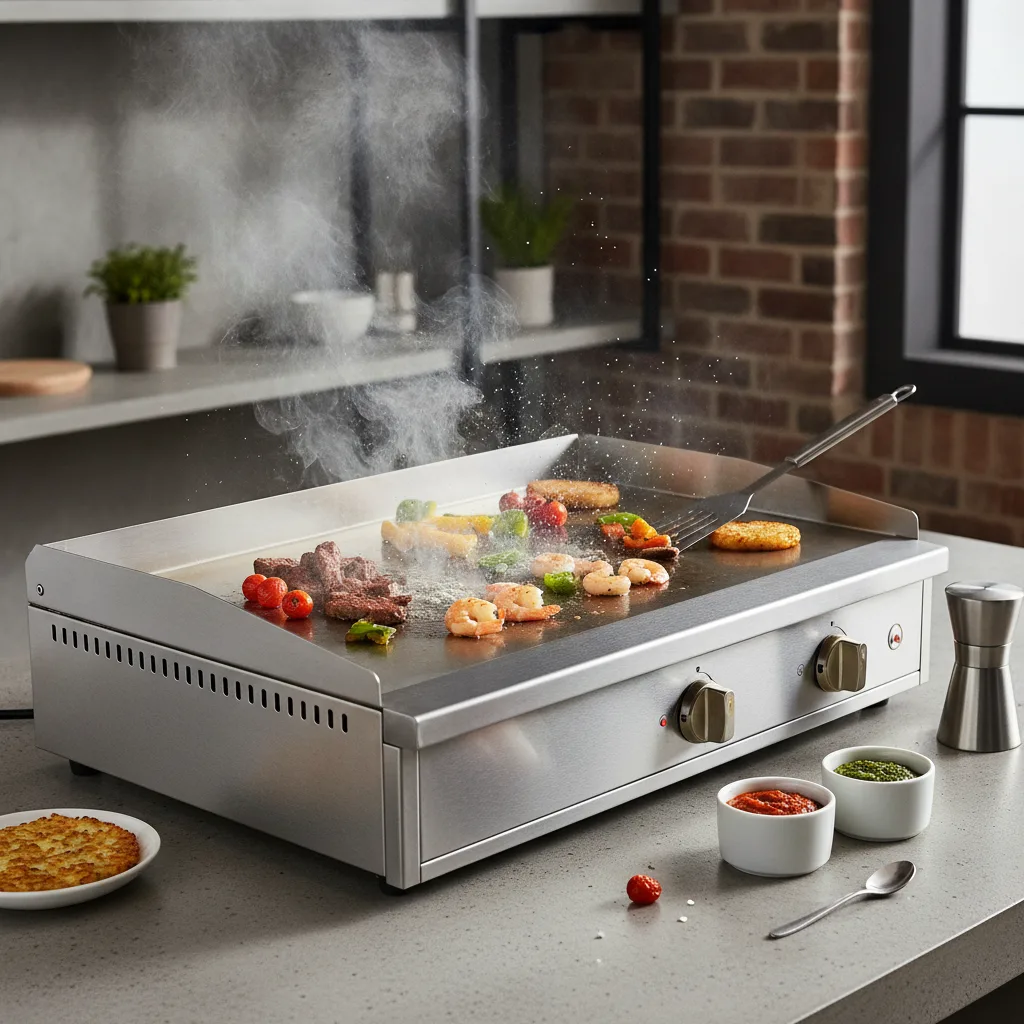
Unlike a barbecue, no flames lick the food, which means you can cook a flatbread as easily as a corn-flour dough or a liquid batter such as a Japanese pancake.
The other advantage is versatility. On the same plate, you can sear marinated meat, melt cheese, warm flatbreads and caramelise onions. A large surface changes everything as soon as you entertain, which explains why our Lux 600 and Lux 830 models are often chosen for group meals, while the Néo 420 is perfect for tables of two to five. Mounted on a trolley, the set-up becomes a real mobile street stall, on the terrace or in the garden.
Preheating and plate temperature: the two keys to successful street food
Preheating time and temperature rise
A plancha that is not hot enough makes food release its water instead of searing it. Allow 10 to 15 minutes of preheating before the first batch, a guideline confirmed by specialist manufacturers. A plate that has properly come up to temperature reaches 250 to 300 °C, but most preparations are cooked below 270 °C.
Electric planchas can be finely adjusted with the thermostat, up to 300 °C on Planchaelec models, which allows much finer control than a flame-based heat source.
| Preparation | Indicative temperature | Cooking guideline |
|---|---|---|
| Flatbreads and wraps (naan, tortillas) | 200 to 220 °C | 1 to 2 minutes per side, plate barely oiled |
| Corn- or rice-flour doughs | 180 to 200 °C | Slow cooking to avoid a crust that is raw inside |
| Sliced vegetables | 180 to 220 °C | 7 to 8 minutes, evenly sized pieces |
| White meat | about 240 °C | Sear, then reduce the power |
| Red meat and minced meat | about 250 °C | Strong searing, cook minced meat through |
| Fish and seafood | 220 to 280 °C | Very short cooking, 1 to 2 minutes per side |
These guidelines of 220 °C for vegetables, 240 °C for white meat, 250 °C for red meat and 260 °C for fish before reducing are notably reported by MGC Prévention. They remain indicative, as thickness, the quantity placed on the plate and the appliance's power change the actual plate temperature.
Good to know
An overloaded plate quickly loses temperature and the food ends up steaming. Always work in small batches, with space between each piece.
Our 10 world snack recipes on the plancha
Naan on the plancha
Naan is a South Asian flatbread made from fermented dough, traditionally slapped onto the wall of a tandoor oven. On a plancha set to around 220 °C, roll the dough out thinly, place it on the plate without fat and let it puff up for 1 to 2 minutes before turning. Brown blisters appear naturally thanks to contact cooking.
Then brush with melted butter and chopped garlic on the still-hot plate. It is the ideal base for a homemade kebab or a wrap of marinated vegetables.
Quesadillas on the plancha
For crispy quesadillas, the rule is to cook over moderate heat, around 200 °C, and to fill lightly. Place the tortilla on the plate, spread a melting cheese over one half, add pulled chicken, beans or mushrooms, then fold. Two to three minutes per side are enough.
A cooking lid speeds up melting the cheese without burning the tortilla, an accessory we offer for our Lux, Néo and Anthéa ranges. Serve with a chilli sauce and lacto-fermented vegetables for acidity.
Okonomiyaki on the plancha
Okonomiyaki is the symbol of Japanese street food, cooked precisely on a steel plate. Yes, it works perfectly on an electric plancha, as long as you stay at around 180 to 200 °C. Mix flour, egg, stock and plenty of shredded cabbage, pour a ladleful onto the oiled plate and form a thick disc.
Allow 5 to 6 minutes per side, without pressing down. Turning requires a wide, rigid utensil. Finish with an umami sauce, Japanese mayonnaise and bonito flakes.
Arepas on the plancha
The arepa, a Venezuelan and Colombian corn bread, is made from a dough of precooked corn flour, warm water and salt. To stop them sticking, three precautions are enough: a well-hydrated, smooth dough, a plate that is preheated but not scorching at around 190 °C, and a film of oil with a high smoke point.
Cook for 6 to 8 minutes per side, until you get a dry crust that sounds hollow. Then split them open and fill with cheese, avocado or pulled pork.
Pajeon, the Korean vegetable pancake
This Korean street pancake combines a batter of rice and wheat flour, egg and plenty of spring onion. Pour a thin layer onto the plate at 210 °C, press lightly to even it out, then let it crisp for 4 minutes before turning.
The secret is a drizzle of oil added around the edges during cooking, which creates a golden fringe. Cut into squares and serve with a vinegared soy sauce.
Marinated chicken tacos
The quesadilla and the taco come from the same Mexican family, but the taco requires meat seared very quickly. Slice chicken thighs, apply a dry rub of smoked paprika, cumin and oregano, then sear at 240 °C in small quantities.
Poultry must be cooked through, a point stressed by the hygiene guide of the French consumer association Que Choisir. Warm the corn tortillas on a cooler zone while the meat rests.
Street smash burger
The plancha is the only surface that allows a real smash burger. Place a ball of minced beef on the plate at 250 °C, press down firmly with the scraper spatula for ten seconds, season with salt and leave it alone. Caramelisation forms within two minutes, then you turn it and add the cheese.
Toast the buns in the rendered fat on a gentler zone. Our stainless steel utensils and accessory pack are designed for this kind of repeated technique.
Homemade shawarma and kebab
To reproduce a spit-roast filling, thinly slice chicken, beef or lamb, leave it in a wet marinade of oil, garlic, lemon and spices, then cook in small handfuls at 240 °C. The strips should brown without drying out.
Serve in a naan cooked just before, with raw vegetables, white sauce and chilli.
Grilled vegetable gözleme
This Turkish turnover works well on the plancha. First grill courgette, pepper and red onion at 200 °C, then fill a thin dough with these vegetables and feta. Fold over and cook for 3 minutes per side with very little oil.
It is the most filling vegetarian option in this selection.
Sweet quesadilla and seared fruit
To finish, lower the plate to around 160 to 180 °C so as not to burn the sugars. A tortilla filled with chocolate and banana, cooked for 2 minutes per side, perfectly rounds off a homemade street food evening. Pineapple, peach or toasted brioche work just as well.
Which oil and which utensils for these snacks?
Avoid fragile oils and choose an oil with a high smoke point, such as groundnut, sunflower or grapeseed oil, applied in a very thin film. Virgin olive oil is better suited to finishing and to vegetables cooked below 200 °C. As for equipment, three tools make the difference for easy homemade street food.
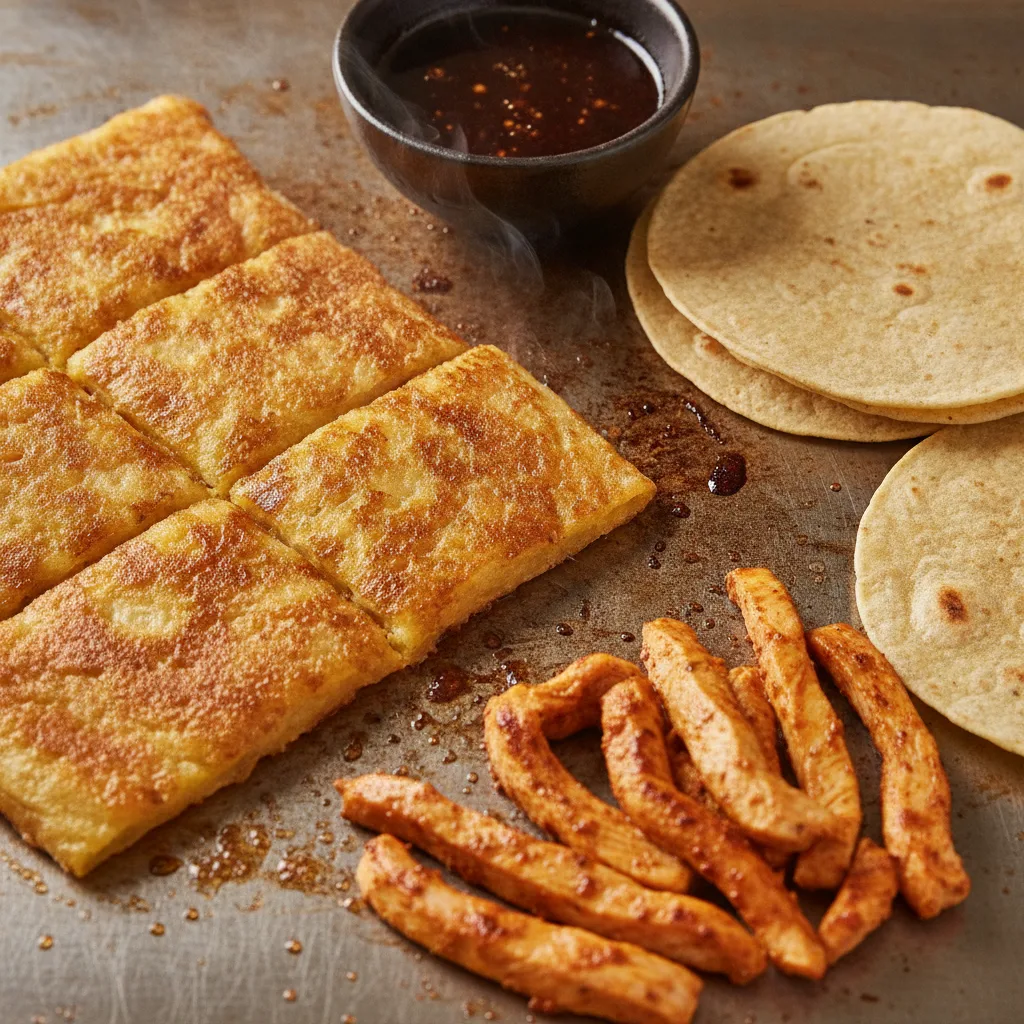
- A wide, rigid scraper spatula, essential for smashing a burger and turning an okonomiyaki.
- A grease collector tray emptied between batches, which avoids smoke from burnt fat.
- Two separate pairs of tongs, one for raw and one for cooked food, to rule out any risk of cross-contamination.
Organising a homemade street food evening with a plancha
Success depends on preparation beforehand. Prepare doughs, marinades, sauces and fillings before switching on, then work in stations. Start with flatbreads and pancakes, continue with vegetables, move on to red then white meat, finish with seafood and clean before the desserts. This order limits flavour transfer and burnt residue.
A large surface such as the Lux 830 lets you dedicate a hot zone to searing and a gentler zone to keeping food warm, which avoids trips back and forth to the kitchen. Set up on a stable trolley, the plancha becomes the centre of the evening, with everyone watching the cooking.
Hygiene and mistakes to avoid
Hygiene rules to follow
The hygiene rules that apply to a barbecue also apply to the plancha. Respect the cold chain, do not leave sensitive preparations at room temperature, keep boards and knives for raw and cooked food separate, and cook poultry, sausages and minced meat through, as Que Choisir points out.
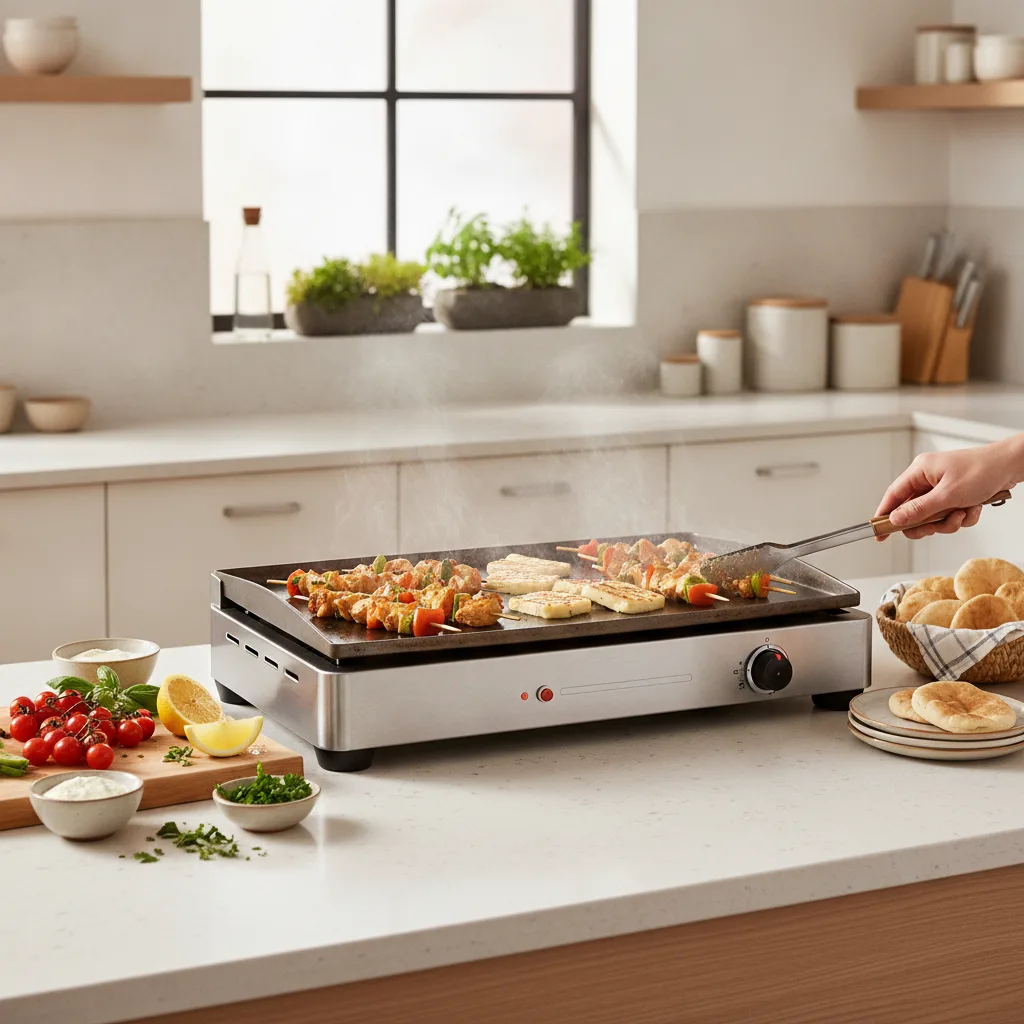
The principles of separation and temperature control also appear in the international standards of the Codex Alimentarius and in the recommendations of the French food safety agency Anses on controlling microbiological risks. For poultry and minced meat, a food thermometer is more reliable than a visual assessment, with usual guidelines placing the core temperature for poultry at around 74 °C.
Key takeaway
Clean the plate between food families, especially after raw chicken, minced meat or seafood. Our stainless steel plancha cleaning guide explains the method for a lukewarm plate.
The most common mistakes are always the same: a plate that is not hot enough, a plate that is overloaded, food that is too wet and salting too early, which draws out water. Dry meat and seafood with kitchen paper, wait for the crust to form before turning, and reduce the temperature as soon as the colour is right.
Going further with plancha street food
With a well-controlled steel plate, you can effortlessly cover a world tour of snacks, from Indian naan to Venezuelan arepas by way of Japanese okonomiyaki and Mexican quesadillas. These recipes from around the world need few ingredients, serious preheating and rigorous batch management.
This is the real strength of a stainless steel electric plancha made in France: a versatility that goes far beyond classic grilling and turns every meal into an improvised street food service.
FAQ
Can you cook these snacks on an electric plancha indoors?
Yes, provided you stay at moderate temperatures for doughs and breads, and ventilate the room. The absence of combustion makes indoor use much simpler than with a flame appliance, as we explain on our page dedicated to indoor and outdoor use.
Do gluten-free doughs stick more to the plate?
Doughs made from corn or rice flour stick more easily because they have less of an elastic network. A perfectly clean plate, a thin film of oil and a stable temperature of around 190 °C are enough to solve the problem.
Do you need a lid for filled snacks?
It is not essential, but it speeds up melting the cheese and cooking thick fillings through without drying out the wrap. It is a useful accessory for quesadillas and vegetable turnovers.
How do you reheat flatbreads prepared in advance?
Fifteen to twenty seconds per side on a zone at 180 °C is enough. Then stack the breads under a clean cloth to keep them soft until serving.
What size of plancha should you choose for a street food evening for ten people?
Allow a surface that lets you cook several preparations at the same time, as street food is served as you go. Widths of 600 to 830 mm, such as our Lux 600 and Lux 830, suit this type of service.