



 +33 4 78 55 45 69
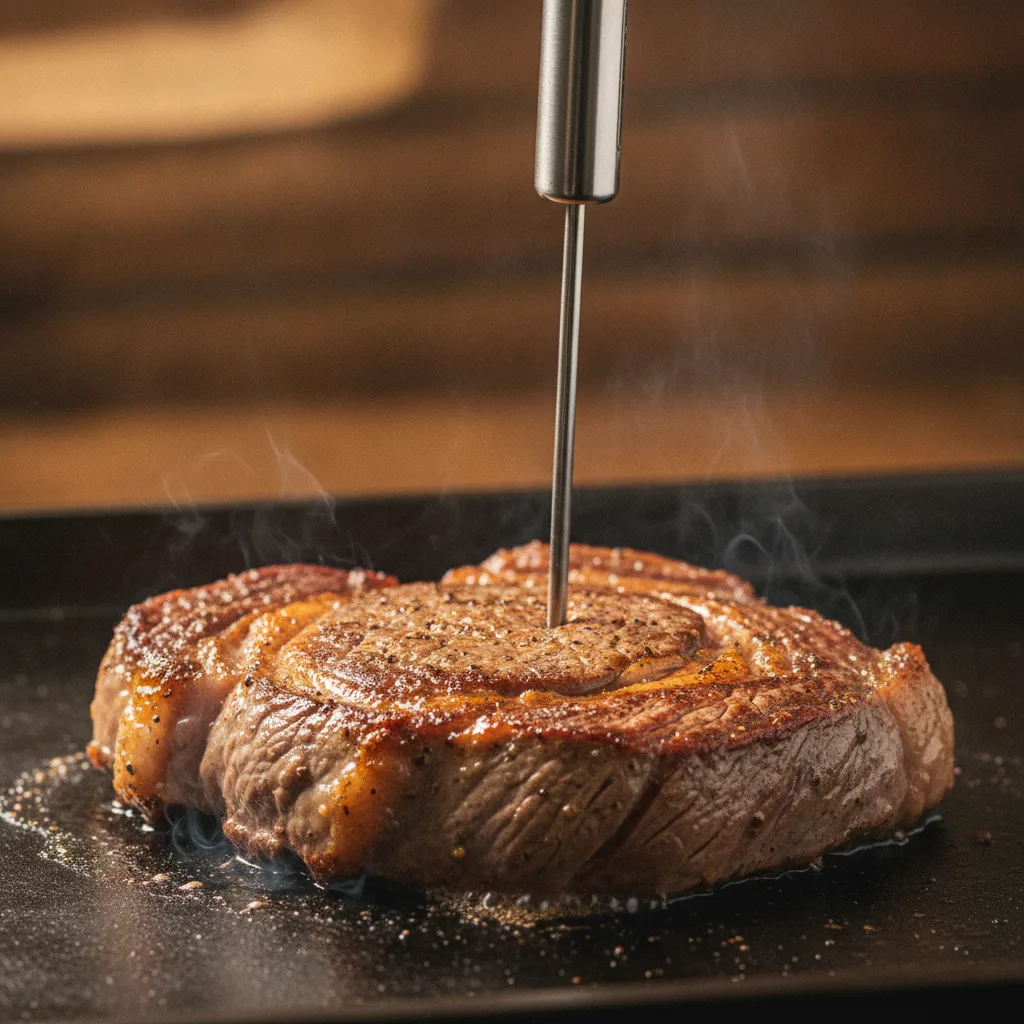
Cooking the perfect steak on the plancha comes down to a few degrees and a few seconds. Too little heat and the meat boils in its juices without ever developing a crust; too long on the plate and the muscle fibres contract, squeezing out all the juiciness.
It relies on simple mechanics: a very hot plate, a well-dried meat surface, searing without handling, a single turn, a check of the core temperature and a resting time. This guide details the guidelines by thickness and doneness, the touch method, using a probe thermometer and the mistakes that ruin a fine piece of meat.
Cooking Steak on the Plancha: The Guide by Thickness 2027
Reading time: ~9 min
- What temperature should a plancha be to cook a steak?
- How long should you cook a steak on the plancha depending on its thickness?
- Blue, rare, medium, well done: core temperatures
- How can you tell whether a steak is rare, medium or well done without cutting it?
- Should you oil the steak or the plancha plate?
- How do you get a good crust on a steak on the plancha?
- Why should you rest a steak after cooking?
- Gas or electric plancha: what are the cooking differences?
- The most common mistakes when cooking a steak on the plancha
- Going further with cooking steak on the plancha
- Frequently asked questions about cooking steak on the plancha
What temperature should a plancha be to cook a steak?
The first rule concerns preheating. A plancha intended for searing beef must reach a high temperature range before the meat touches the stainless steel. We recommend a setting between 220 and 240 °C, with 10 to 15 minutes of preheating depending on the model and the outdoor temperature.
Weber, for its part, indicates a steak searing range of between 230 and 280 °C. These values point to the same idea: the cooking plate must be able to sear at high temperature immediately, without a sudden drop in heat when the meat touches it.
This requirement explains why the plate's thermal inertia matters as much as the stated power. A thick stainless steel plate, like those on our electric planchas Néo 420, Lux 600 or Lux 830, releases heat evenly and does not collapse thermally when you place three or four pieces at once.
Preheating that is too short is the most common mistake: the plate feels hot to the touch but its core is not yet hot, and the surface colour stays pale.
Central searing zone and gentle outer zone
A plancha is not a uniform surface, and that is an advantage. The centre of the plate, above the heating element, is the central searing zone, the hottest. The edges offer more moderate direct heat, useful for finishing cooking without burning the crust.
This is also the logic recommended by La-Viande.fr, with the centre for searing and the outer edge for gentle finishing. On a thick steak, moving it from the centre to the edge gives even cooking while limiting the temperature gradient between surface and core.
How long should you cook a steak on the plancha depending on its thickness?
The cooking time of a steak on the plancha depends not on the weight of the piece but on its thickness. A thinly cut 400 g rib-eye cooks faster than a thickly cut 200 g steak.
Cooking time guidelines by thickness
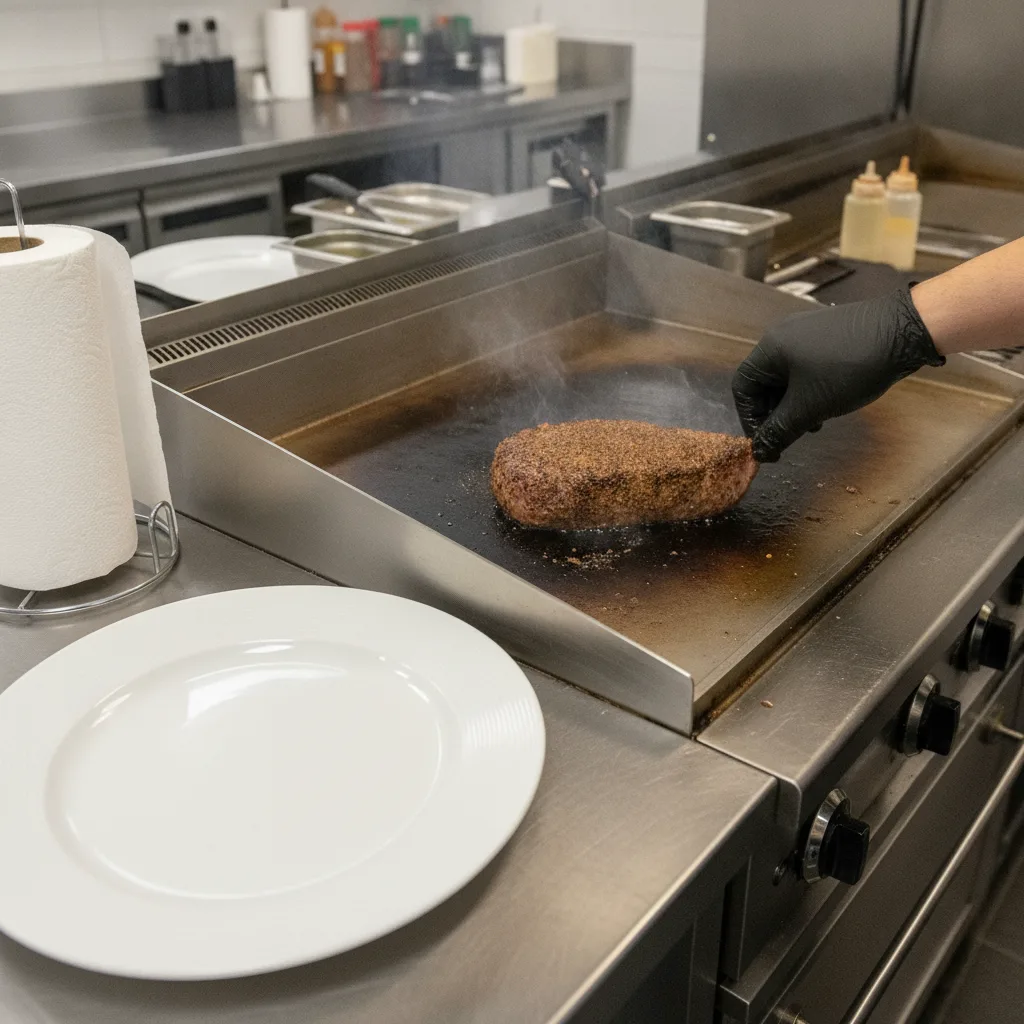
For a steak about 2 cm thick, we use simple guidelines: about 2 minutes per side for a rare steak, 3 minutes per side for a medium steak and 4 minutes per side for a well-done steak. The following table extends these guidelines to other thicknesses, bearing in mind that they are indications to adjust according to the actual plate temperature, the starting temperature of the meat and the cut.
| Steak thickness | Blue | Rare | Medium | Well done |
|---|---|---|---|---|
| 1.5 cm | 45 s per side | 1 min 30 per side | 2 min per side | 3 min per side |
| 2 cm | 1 min per side | 2 min per side | 3 min per side | 4 min per side |
| 3 cm | 1 min 30 per side | 2 min 30 to 3 min per side | 4 min per side | 5 to 6 min per side |
| 4 cm and over | 2 min per side in the centre | 2 min per side, then 2 to 3 min in the outer zone | 2 min per side, then 5 to 6 min in the outer zone | 2 min per side, then 8 min in the outer zone |
Key takeaway
Beyond 3 cm thick, the minutes become secondary and only checking the core temperature guarantees the result. Sear in the centre, then finish in the gentle outer zone with a probe thermometer.
Blue, rare, medium, well done: core temperatures
The core temperature of the steak is the most reliable guide, because it depends neither on the power of your appliance nor on the size of the piece. Commonly accepted values put blue at around 45 to 48 °C, rare between 52 and 55 °C, medium-rare at around 55 °C, medium between 60 and 63 °C, and well done above 70 °C.
Traeger also points out that an internal temperature of 63 °C corresponds to safe cooking for a steak, even though many enthusiasts prefer lower cooking to preserve the meat's juiciness.
Core temperature table
| Doneness | Core temperature |
|---|---|
| Blue | 45 to 48 °C |
| Rare | 52 to 55 °C |
| Medium-rare | about 55 °C |
| Medium | 60 to 63 °C |
| Well done | over 70 °C |
An often overlooked technical point: cooking continues after the meat is removed from the plate. The heat stored at the surface keeps migrating towards the centre and generally raises the core temperature by a few degrees during resting. So take the meat off slightly before the target, especially for thick pieces.
How can you tell whether a steak is rare, medium or well done without cutting it?
Cutting the steak to check its doneness is the best way to lose its juices. Two methods avoid this sacrifice.
Cooking thermometer
The first is the cooking thermometer: a probe inserted horizontally into the centre of the piece, without touching bone or fat, gives an immediate, objective reading. It is the most reliable method, especially on a thick steak where the temperature gradient is significant.
Touch method
The second is the touch method, useful when no thermometer is available. It involves comparing the resistance of the meat under your finger with that of the base of your thumb: relaxed hand for blue, thumb touching the index finger for rare, the middle finger for medium, the ring finger for more cooked. The more the meat has contracted, the further the cooking. This method takes practice, but it improves quickly once you check it once or twice against a probe reading.
Should you oil the steak or the plancha plate?
The answer is clear: oil the meat, not the plate. A thin film of oil applied to the steak, with a brush or simply by hand, is enough to ensure thermal contact and prevent sticking. Poured onto a plate at 240 °C, oil smokes immediately, breaks down and leaves a sticky deposit that then makes cleaning the stainless steel harder. Choose an oil that withstands heat and use it sparingly: excess causes unnecessary smoke.
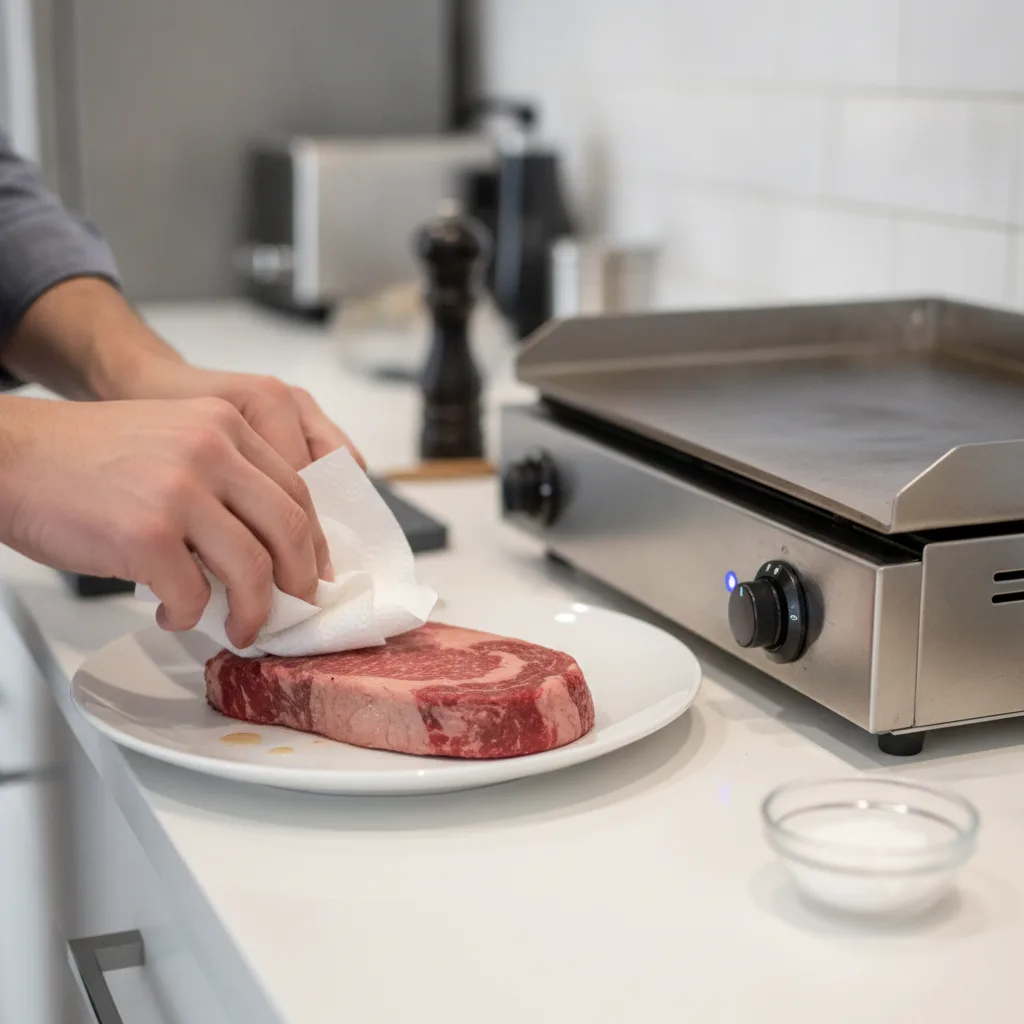
Before oiling, carefully dry both sides with kitchen paper. Surface moisture is the enemy of the crust, because the water must first evaporate before the surface exceeds the browning threshold. A steak taken out of the fridge 20 to 30 minutes before cooking, brought to temperature and dried, browns much faster than a cold, damp piece.
How do you get a good crust on a steak on the plancha?
The golden crust is the product of the Maillard reaction, the encounter between amino acids and sugars that generates the aromatic compounds typical of grilled meat. It starts at around 115 °C and gives its best results between 140 and 165 °C at the surface, developing rapidly above 140 °C. It has nothing to do with simple enzymatic browning: this is a thermal phenomenon that requires a really hot plate and a dry surface.
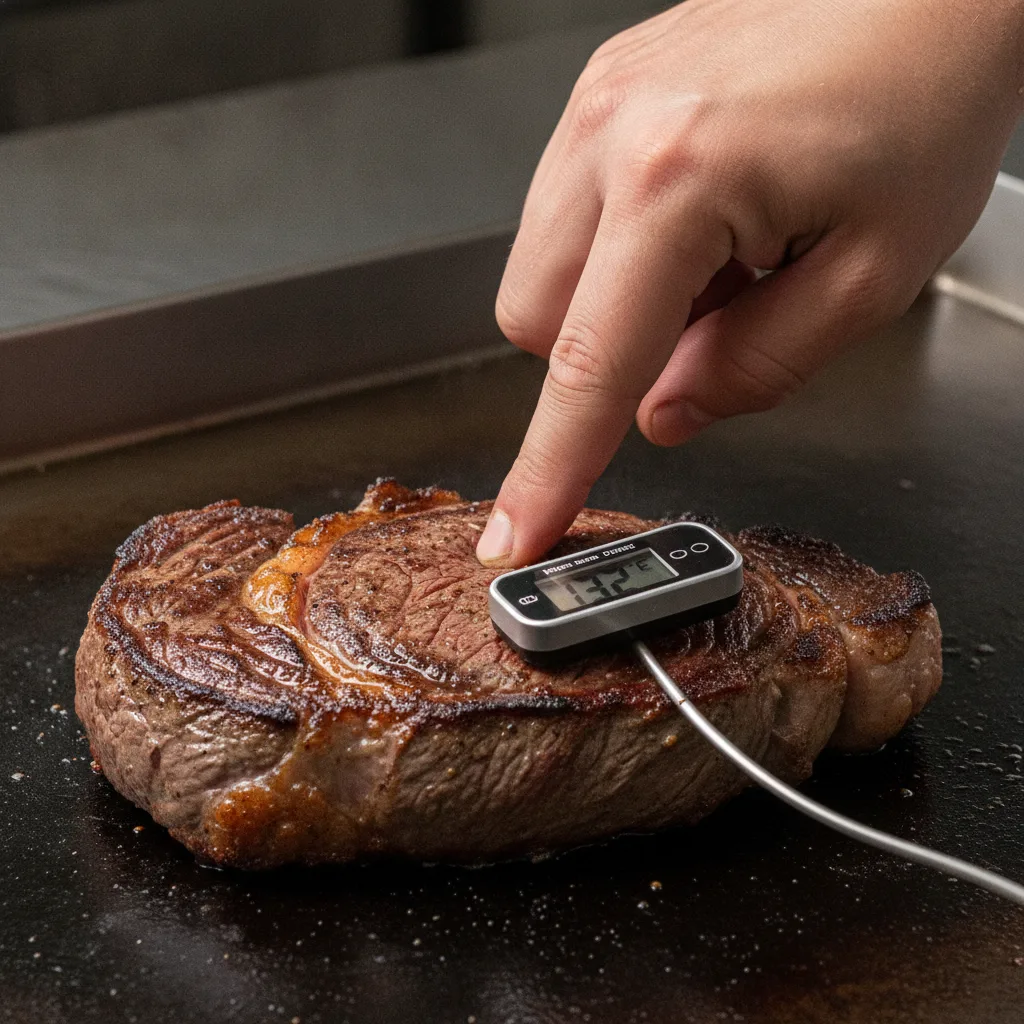
Three actions determine this crust. The first is to place the steak and not touch it again until the surface colour has formed and the meat releases naturally. The second is turning it only once, using serving tongs rather than a fork, which would pierce the fibres. The third is leaving space between pieces: an overloaded plate generates steam and blocks the reaction. Our scraper spatula and serving tongs are designed for these precise movements on stainless steel.
Good to know
Salting before cooking does not prevent a good crust if the salt is applied just before searing or, conversely, at least 40 minutes beforehand. It is between these two windows that salt brings moisture to the surface and delays browning.
Why should you rest a steak after cooking?
Resting the meat after cooking is not a chef's detail but a physical step. During searing, the muscle fibres contract and push the juices towards the centre of the piece. If you slice immediately, these juices escape onto the plate.
A rest of 2 to 5 minutes, under foil or a cooking lid, allows the juices to redistribute and the temperature to even out between the outside and the core. The result is a juicy steak, evenly pink and much more tender.
For a 4 cm thick piece, extend this rest to 5 minutes. For a thin 1.5 cm steak, 2 minutes is enough: beyond that, the meat cools unnecessarily. Use this time to plate the side dishes, vegetables or potatoes already cooked in the outer zone while the plate was heating up.
Gas or electric plancha: what are the cooking differences?
Both technologies sear very well, but they are not controlled in the same way. Gas heats up quickly and reacts fast to a change in setting, which is convenient for cooking large quantities in succession, but heat distribution is often more pronounced above the burners. Electric models, with a thermostat, offer more linear regulation and a more stable temperature over time, particularly useful for cooking a 2 cm steak consistently from one meal to the next. They can also be used indoors and outdoors, with no gas bottle or hose to manage.
In practice, the difference lies in consistency. On a properly sized stainless steel electric plancha, once the plate has stabilised at 230 °C, it stays there. Our Lux 600 and Lux 830 models are designed for this consistency, with a solid stainless steel plate and an adjustable thermostat, and our Monceau, Rivoli, Élysée or Odéon trolleys let you set them up comfortably on a terrace.
The most common mistakes when cooking a steak on the plancha
Most failures come from four recurring causes that we see again and again in our customers' questions. Here they are, with the corresponding fix.
- Plate not hot enough: the meat releases its water and stews without a crust; fix it by preheating for 10 to 15 minutes.
- Damp surface or meat straight from the fridge: dry with kitchen paper and leave to temper for 20 to 30 minutes.
- Repeated handling: every move breaks the formation of the crust; a single turn is enough.
- No resting: the juices end up on the plate; allow 2 to 5 minutes depending on thickness.
A fifth mistake deserves a mention: overloading the plate. It is better to cook in two batches, keeping the first pieces warm under a cooking cloche, than to put everything on at once and make the plate temperature drop by 50 °C.
Going further with cooking steak on the plancha
Cooking a steak perfectly on the plancha requires neither a secret recipe nor exotic equipment, just a sequence followed carefully: a stainless steel plate heated to 220 or 240 °C, dry, tempered meat, firm searing without touching it, a single turn, a probe check between 52 and 55 °C for rare or 60 and 63 °C for medium, then a few minutes' rest.
The times given by thickness are starting points: the core temperature remains the final arbiter. With a stable stainless steel electric plancha and a few suitable utensils, these guidelines quickly become second nature, and the same result is reproduced meal after meal.
FAQ – Frequently asked questions about cooking steak on the plancha
Can you cook a frozen steak directly on the plancha?
It is possible with a thin piece, but the result is rarely even: the surface browns before the centre has thawed. We recommend thawing slowly in the fridge, then drying carefully with kitchen paper before searing.
Do you need a lid to cook a steak on the plancha?
For searing, no: the lid would trap steam and spoil the crust. It becomes useful for a very thick piece to finish over gentle heat, or to keep cooked steaks warm during service.
Which cut should you choose for a successful rare steak?
Fine-grained cuts that are thick enough, cut to 2 or 3 cm, are best suited to rare cooking. A piece that is too thin reaches the core before it has browned, forcing you to choose between crust and pink cooking.
How do you clean the plate after cooking steak?
Cleaning is done while the plate is still warm, loosening residue with a scraper spatula and then using a scouring pad and a degreaser suitable for stainless steel. We offer a cleaning accessory pack dedicated to this routine, which preserves the plate's polish over time.
Is the plancha suitable for other meats with the same guidelines?
The principles remain valid: hot plate, dry surface, single turn and resting, but core temperatures vary by meat. Beef can be cooked to lower temperatures, while poultry and pork require higher internal temperatures.