



 +33 4 78 55 45 69
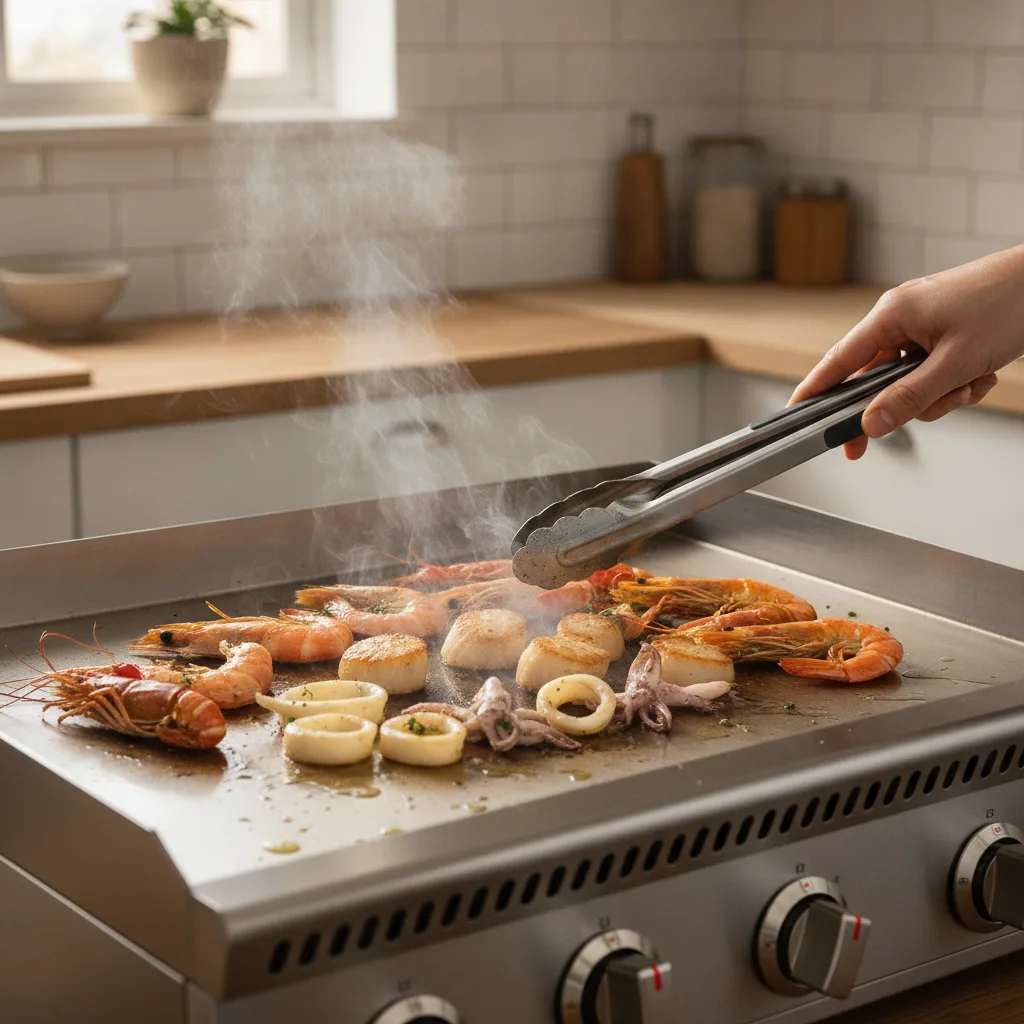
Cooking seafood on the plancha comes down to a few tens of seconds. A perfect prawn is pearly and juicy, while a prawn left thirty seconds too long becomes dry and rubbery. Prawns, scallops, squid, langoustines: each species has its own rhythm, its own size and its own tolerance to heat.
This guide brings together precise times and temperatures, the visual signs of perfect cooking and the mistakes that spoil a seafood platter. At Planchaelec, we make stainless steel electric planchas in France, and these are the guidelines we have been passing on to our customers for years.
Cooking Seafood on the Plancha: Exact Times by Species
Reading time: ~7 min
- Why cooking seafood on the plancha requires precision
- What temperature should you use to cook seafood on the plancha?
- Table of cooking times by species
- Prawns, king prawns and the question of peeling
- Scallops, squid and langoustines: three different approaches
- Marinade, deglazing and seasoning
- The mistakes that make seafood rubbery
- Which plancha should you choose for cooking seafood?
- Frequently asked questions about cooking seafood on the plancha
- Going further with cooking seafood on the plancha
Why cooking seafood on the plancha requires precision
Seafood contains little collagen and a lot of water. Its proteins contract very quickly under heat, which explains why overcooking by thirty seconds is enough to turn tender flesh into a rubbery texture.
Seafood cooking specialists, such as Coquillages Claude, identify three recurring causes of disappointment: overcooking, heat that is too aggressive at the start and poorly managed timing between the different species on the plate.
The plancha nevertheless remains the most suitable tool. High-temperature searing on a solid stainless steel plate immediately creates a golden colour and seals the juices inside the flesh. Unlike a barbecue, no flame dries the produce from below, and the juices stay on the plate, where they will be used for deglazing.
You still need even heat distribution and enough thermal inertia so that the plate does not drop in temperature as soon as the first cold king prawns are placed on it.
What temperature should you use to cook seafood on the plancha?
Ideal temperature for controlled cooking
The reference range is between 200 and 250 °C. This is what we indicate in our guide to plancha cooking temperatures for prawns and scallops. Below 200 °C, seafood releases its water, boils instead of searing and loses its texture. Above 250 °C, the outside browns too quickly while the centre stays raw, a phenomenon particularly visible on thick scallops.
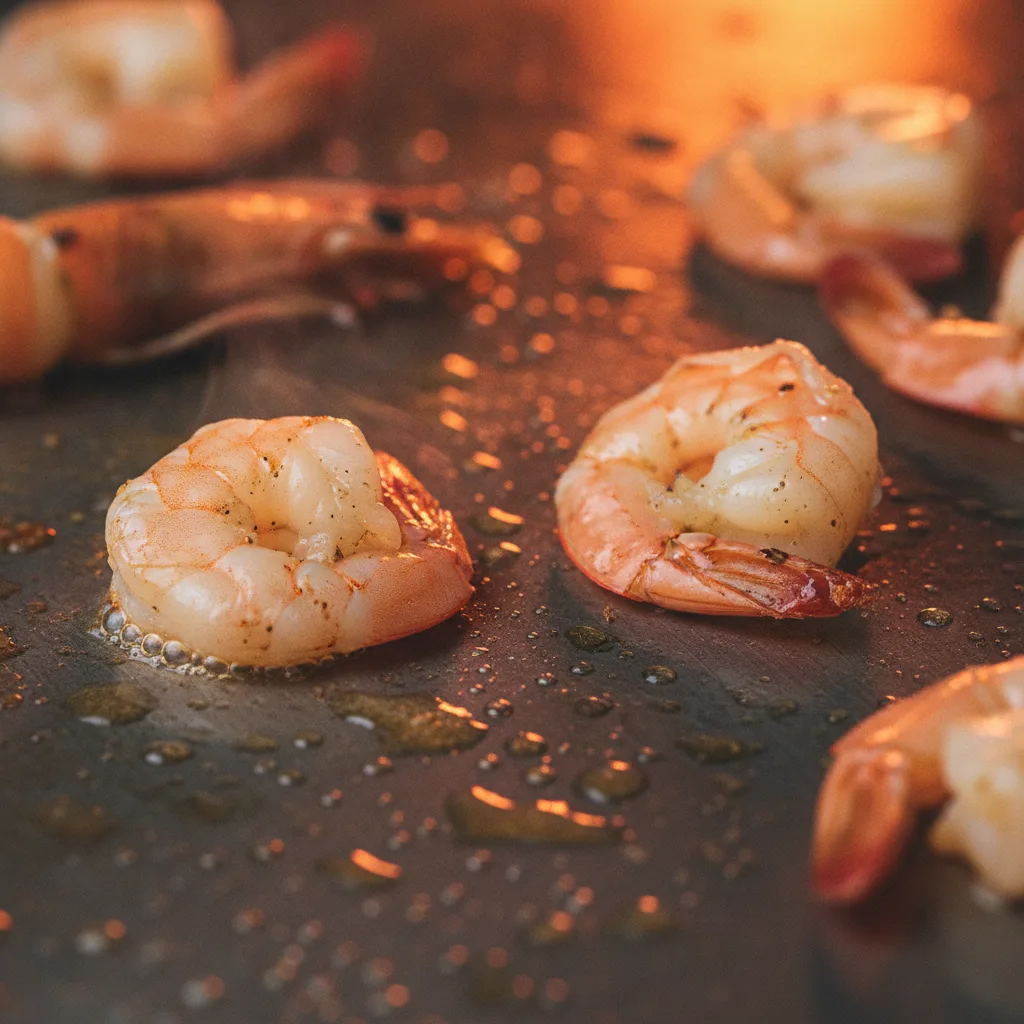
Preheating determines everything else. Allow 10 to 15 minutes before placing the first product, so that the whole mass of stainless steel reaches a stable temperature, not just the surface. A plancha preheated too quickly has uneven hot zones, which gives irregular cooking during a single service.
On our models, the thermostat lets you go down to 180 °C for delicate shellfish and up to 240 °C for squid, which needs very fierce searing.
The plate is oiled with a thin layer of olive oil applied just before placing the produce, never during preheating. An alternative popular on the coast is to sprinkle a generous layer of coarse salt over the hot plate, a technique that protects the most delicate flesh and makes cleaning easier afterwards.
Table of cooking times by species
Cooking time guidelines by species
Here are the guidelines we use, size by size. The times are given for a properly preheated plate and produce taken out of the fridge fifteen minutes beforehand.
| Species | Size / thickness | Temperature | Total time | Sign of doneness |
|---|---|---|---|---|
| Peeled prawns | 20 to 30 per kilo | 220 °C | 3 minutes | Pearly flesh, supple C shape |
| Shell-on prawns | 20 to 30 per kilo | 220 °C | 5 minutes | Bright orange shell, legs retracted |
| Whole king prawns | Large, 10 to 15 per kilo | 230 °C | 5 to 6 minutes | Crunchy shell, opaque flesh |
| Scallops | 2 to 3 cm thick | 240 °C | 1 min 30 to 2 min per side | Golden crust, translucent centre |
| Queen scallops | 1 cm thick | 230 °C | 45 seconds per side | Light golden colour, supple flesh |
| Squid strips | 5 mm | 240 °C | 1 to 2 minutes | Edges that curl up |
| Whole baby squid | Small, 4 to 6 cm | 240 °C | 2 to 3 minutes | Opaque white flesh, light colour |
| Whole langoustines | Medium | 200 °C | 2 to 3 min then 3 to 4 min under a cloche | Flesh comes away from the shell |
Two other preparations complete these guidelines. Rope-grown mussels cook at 220 °C: allow one minute for them to open, then 1 to 2 more minutes, until the shell is open and the flesh has shrunk. A mixed pan of peeled seafood needs 220 °C for 10 to 15 minutes, until you get caramelised juices and an evenly golden result.
Prawns, king prawns and the question of peeling
To peel or not before cooking on the plancha
The question comes up every time: should you peel prawns before cooking them on the plancha? The answer depends on the result you want. The shell protects the flesh, concentrates the flavours and prevents drying out, but it extends cooking by about two minutes and makes eating them less convenient.
Traditional Basque recipes keep the shell on langoustines and large pieces, and peel prawns and king prawns when they go into a mixed pan, so that they cook evenly with the other species.
An effective compromise is to split the back of the prawn along its whole length without removing the shell. The heat penetrates better, the marinade seeps in, and the shell continues to act as a shield. The visual stop signal is simple: as soon as the prawn forms an open C, it is cooked. If it curls up into a tight O, it is already overcooked.
Good to know
Take seafood out of the fridge a quarter of an hour before cooking. Ice-cold produce makes the plate temperature drop and causes stewing instead of real searing.
Scallops, squid and langoustines: three different approaches
Adapting cooking to the texture of each product
The difference between cooking squid and scallops illustrates the two extremes well. A scallop is thick and dense; it needs firm searing on each side to develop a golden crust while keeping a slightly translucent centre. It is turned only once and never moved during the first side, or you will break the forming crust.
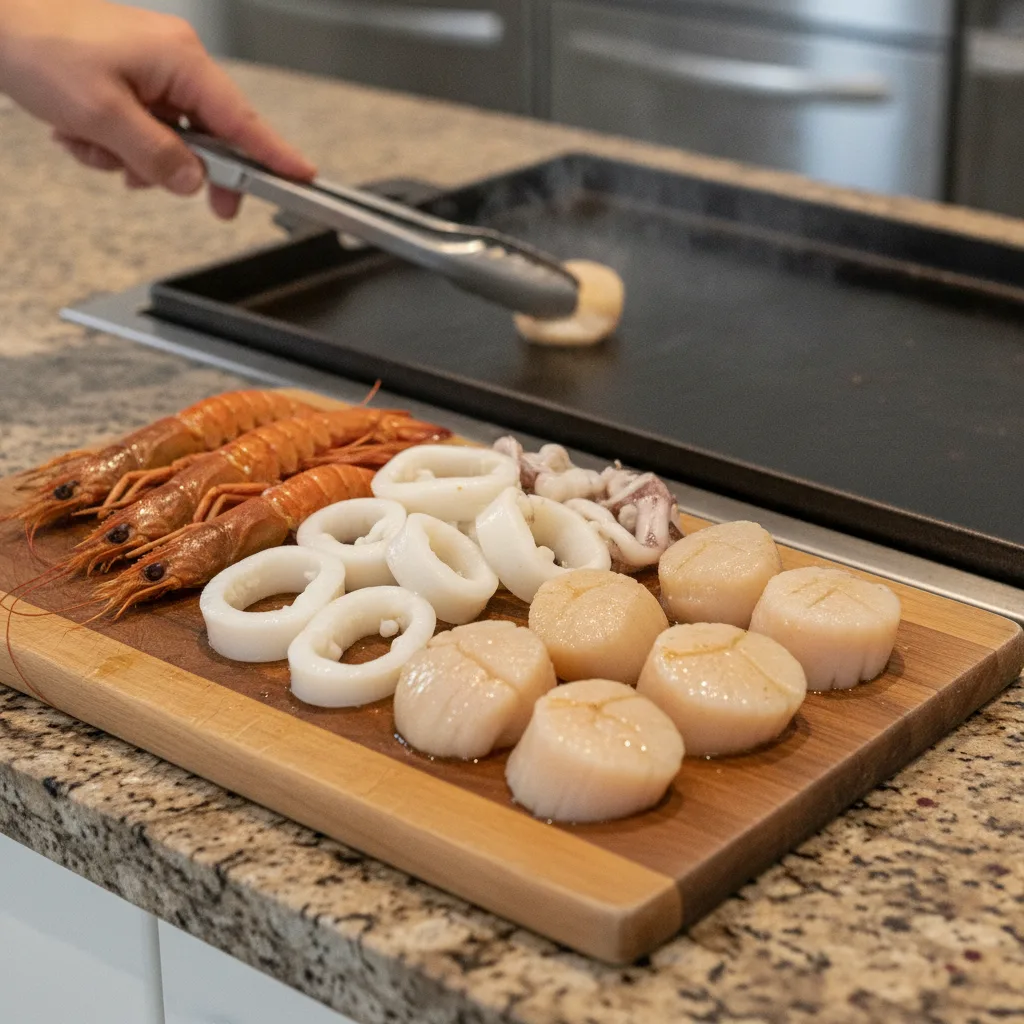
Squid, on the other hand, is thin and essentially muscle; it goes from tender to rubbery in under a minute. Only two options work: very short cooking at very high temperature, or long, gentle cooking in a casserole, which is not the role of a plancha.
Langoustines sit in between. To cook them without drying them out, the method approved by specialist blogs is to sear them for two to three minutes shell side down over moderate heat, then finish for three to four minutes under a cooking cloche. The trapped steam gently finishes the job without harming the flesh. Our stainless steel lids fulfil exactly this function, and also let you open mussels that have been cleaned and debearded beforehand.
Marinade, deglazing and seasoning
A marinade for seafood on the plancha stays simple: olive oil, lemon juice or vinegar, garlic, shallot, parsley or herbes de Provence. Reference recipes recommend one to two hours in the fridge, no more, as the acidity of lemon starts to break down the flesh beyond that. Always drain the produce before placing it on the plate: excess liquid cools the plate and prevents browning.
Deglazing is the finishing touch of a good seafood pan on the plancha. At the end of cooking, a splash of white wine, vinegar or lemon juice on the plate loosens the cooking juices and creates a short sauce that you bring back over the produce with the spatula. It is also the first step in cleaning, since the residue comes away immediately.
The mistakes that make seafood rubbery
Before you start cooking, keep in mind the most frequent pitfalls seen in practice.
- Putting all the produce on at the same time even though their cooking times range from 45 seconds to 6 minutes, which guarantees at least one overcooked species.
- Overloading the plate, which makes the temperature drop and turns searing into boiling.
- Neglecting to clean shellfish of sand and to debeard mussels, a hygiene detail recalled by all good practices inspired by HACCP principles.
- Turning scallops three times out of curiosity instead of once.
- Believing that seafood only cooks on the plate, when residual heat extends cooking by about a minute on the serving plate.
The freshness of the produce remains non-negotiable. Soft flesh, an ammonia smell or open shells that do not close when tapped rule out the product, whatever the quality of your equipment.
Which plancha should you choose for cooking seafood?
Three criteria really matter: the ability to reach and hold 250 °C, even heat distribution, and ease of cleaning. Solid stainless steel ticks all three boxes. It resists salty juices and moisture from shellfish, does not flake and withstands daily scraping with a spatula. Enamelled cast iron offers good thermal inertia, but its coating does not stand up well to knocks and salt over time. To learn more about this choice, see our comparison stainless steel or enamelled cast iron plancha.
In terms of surface, a Néo 420 suits two to four guests, a Néo 530 up to eight people, a Lux 600 up to ten, a Lux 830 up to fifteen and an Anthéa 870 up to sixteen.
For seafood, choose models with two independent heating zones: you sear the squid on the hottest zone while the langoustines finish gently on the other. A grease collector and a suitable degreasing cleaner complete the equipment, as briny residue should be removed the same day.
Key takeaway
A stainless steel electric plancha with thermostatic control remains the best ally for seafood, because it lets you choose a precise temperature rather than putting up with it.
FAQ – Frequently asked questions about cooking seafood on the plancha
Can you cook frozen seafood on the plancha?
Yes, provided you thaw it completely in the fridge and then pat it dry carefully. Produce that is still wet releases water that prevents any searing and makes the plate temperature drop.
Should you salt seafood before or after cooking?
After, every time. Salt applied beforehand draws water out of the flesh by osmosis and prevents golden browning. Fleur de sel and pepper are added when serving.
How much seafood should you plan per person?
Allow about 250 to 300 grams of peeled seafood per guest as a main course, and 150 grams as a starter or as part of a mixed parrillada.
How do you clean a plancha after cooking seafood?
Deglaze the still-hot plate with a little water or white wine, scrape with the scraper spatula towards the grease collector, then use a scouring pad with a degreasing cleaner suitable for stainless steel. Briny residue should never be left to dry on the plate.
Can you cook seafood on the plancha indoors?
Yes, with an electric plancha, which produces no flame or combustion. Provide a cooker hood or an open window, as shellfish give off quite noticeable briny vapours.
Should lemon be added during or after cooking?
After, except in a marinade beforehand. Added to the hot plate, lemon juice cools the surface and cooks the flesh by acidity instead of searing it.
Going further with cooking seafood on the plancha
Successfully cooking seafood on the plancha comes down to three decisions: preheating to between 200 and 250 °C for ten to fifteen minutes, sticking to short times suited to each size, and relying on visual signs rather than the timer alone.
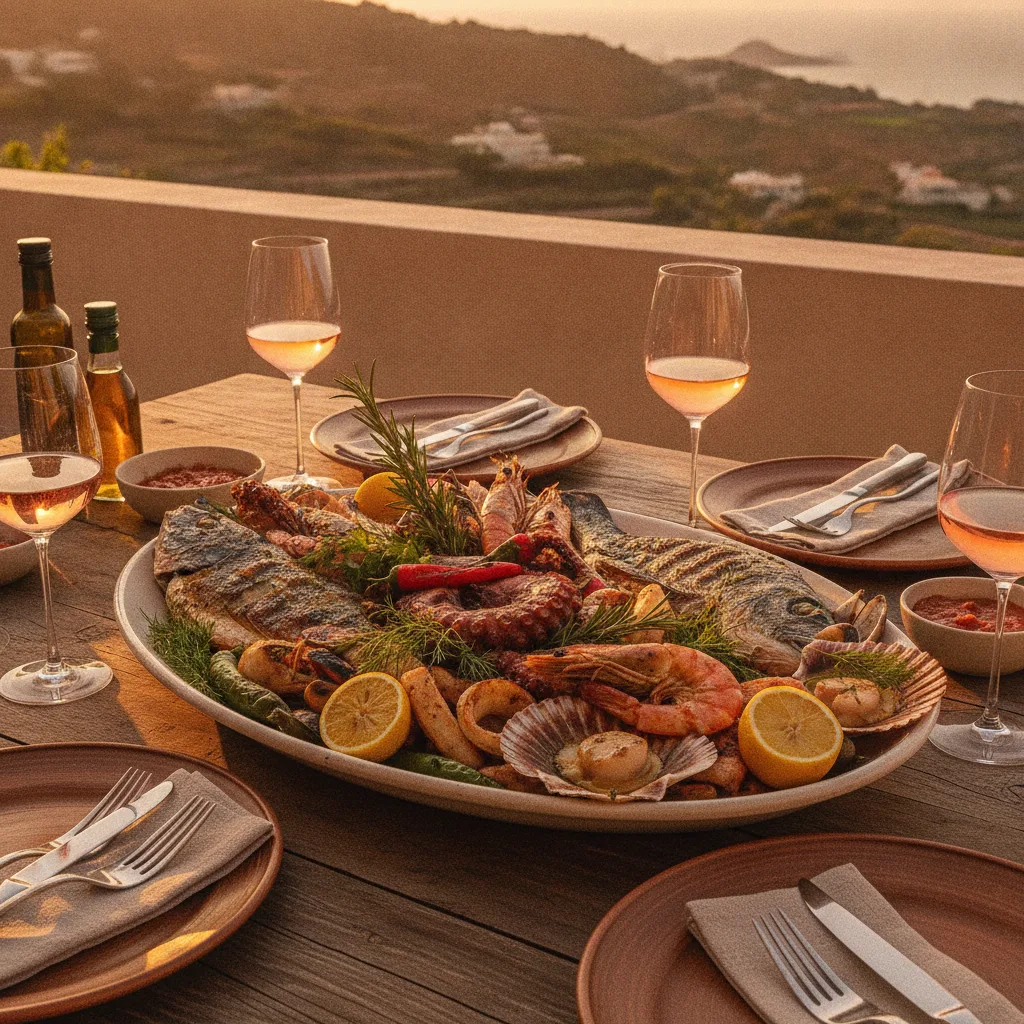
The rest is pure pleasure: a parrillada shared on the terrace, deglazing with white wine and cooking juices collected at the last second. Our stainless steel electric planchas made in France are designed for this precision, and our user and cleaning guides support you once the appliance is set up.