



 +33 4 78 55 45 69
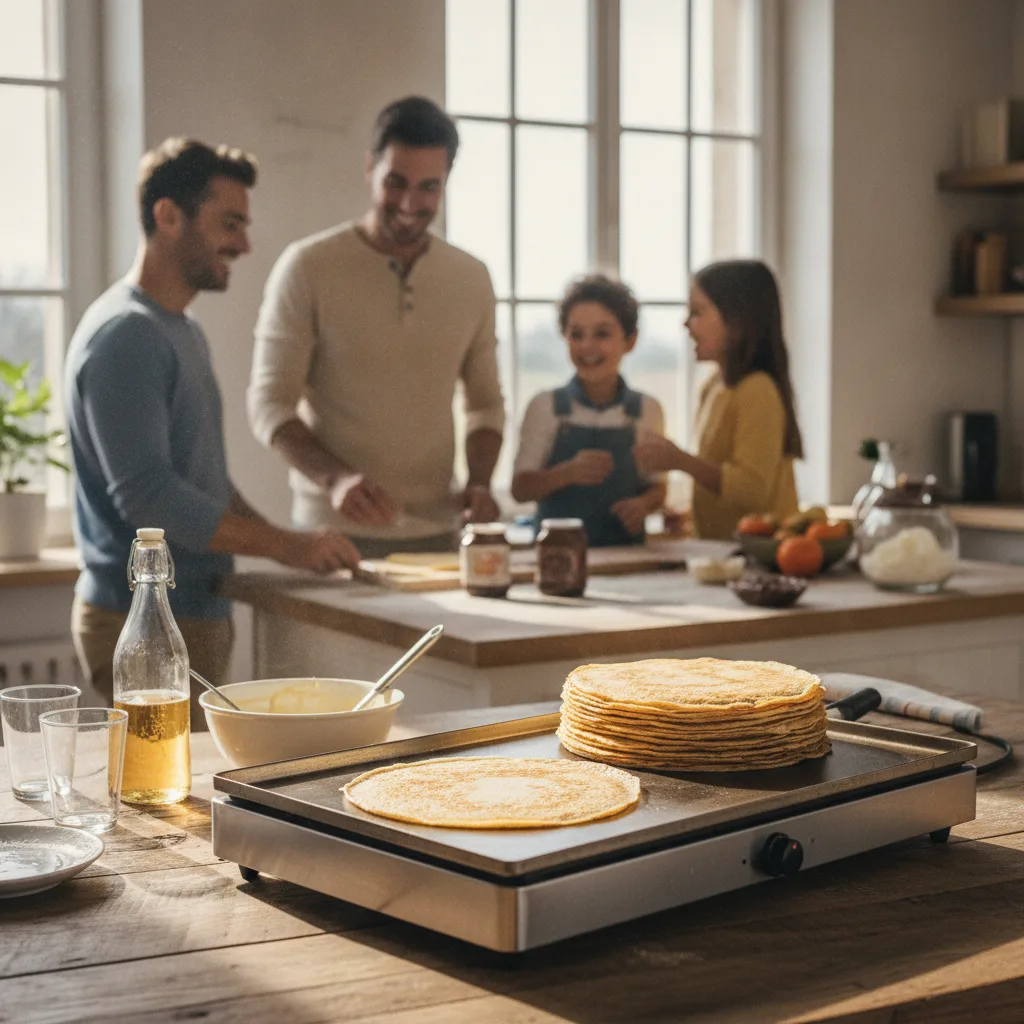
Pancake Day is coming up, or perhaps you just fancy a family Sunday around a stack of golden crêpes: the question comes up often. Can you use a plancha for crêpes instead of a traditional crêpe maker? The short answer is yes, as long as you follow a few simple rules.
The smooth surface of a stainless steel plancha even offers some advantages a traditional crêpe maker does not, notably the ability to cook several crêpes at the same time. In this article, we explain how to get the most out of your electric plancha to make perfect crêpes every time.
Stainless steel plancha for crêpes: tips and tricks
Reading time: ~7 min
- Summary
- Plancha or crêpe maker: which should you choose for making crêpes?
- What temperature should you set your plancha to for cooking crêpes?
- Why do crêpes stick to a stainless steel plancha?
- Why use an electric plancha for crêpes?
- What plancha size is enough to make several crêpes at once?
- Practical guide: making crêpes on the plancha step by step
- Key points for your plancha crêpes
- Frequently asked questions about plancha crêpes
Summary
- Plancha vs crêpe maker: a plancha can replace a crêpe maker, with advantages in surface area and versatility, but a few adjustments are needed.
- Ideal temperature: setting the plancha to around 180 to 200 °C is the key to nicely golden crêpes that don't burn.
- Why they stick: insufficient greasing or a poorly seasoned plate are the main causes, and the solutions are easy to put in place.
- Electric plancha: its precise thermostat keeps the heat steady, ideal for crêpes.
- Practical use and care: a few simple steps before and after cooking guarantee stick-free sessions.
Plancha or crêpe maker: which should you choose for making crêpes?
Choosing between a plancha and a crêpe maker for your crêpes
A traditional crêpe maker, whether electric or cast iron, is designed specifically for thin Breton-style crêpes or buckwheat galettes. Its diameter is usually between 30 and 40 cm, and its automatic thermostat is calibrated for this type of cooking. The plancha, on the other hand, offers a much larger cooking surface, often between 40 and 83 cm depending on the model, which means you can cook two or three crêpes at once.
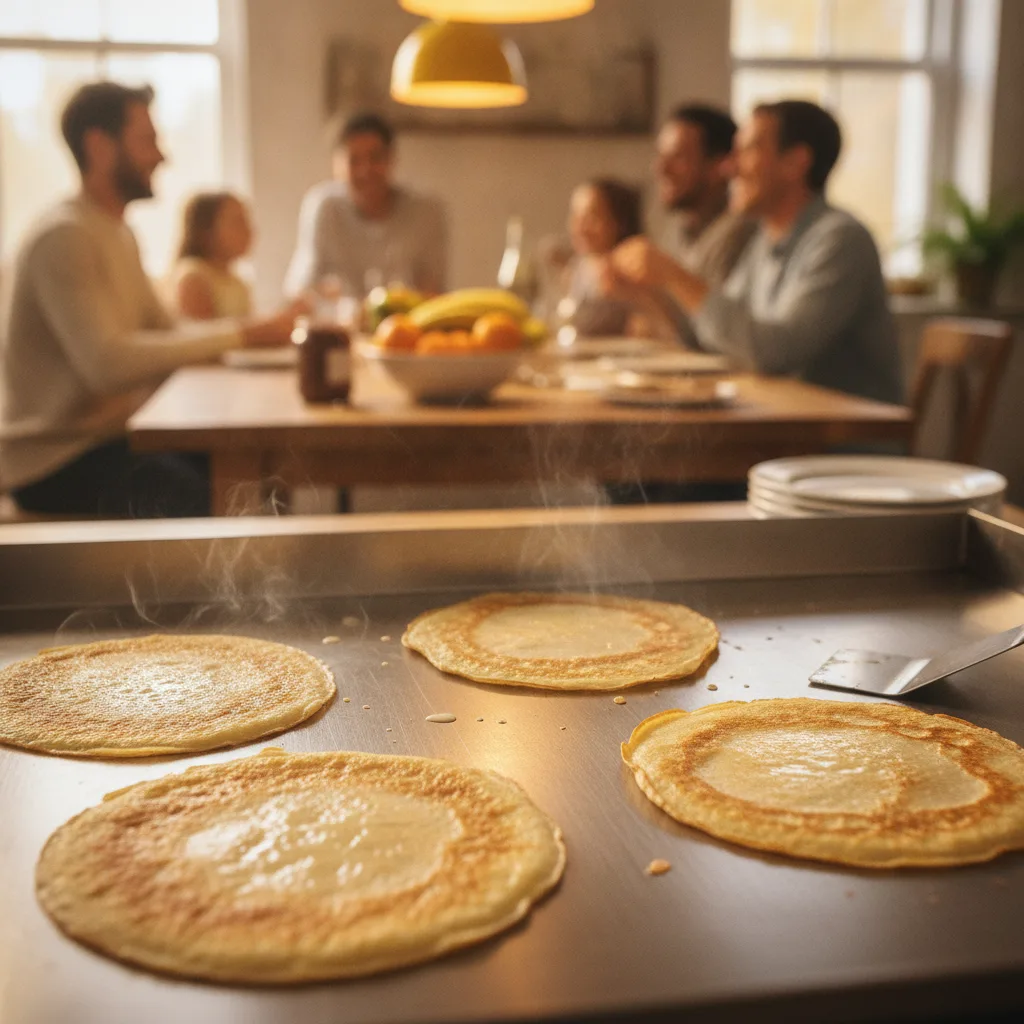
The main difference lies in how precisely it heats up. A dedicated crêpe maker quickly reaches a very even heat across its whole surface, which makes spreading the batter easier. A stainless steel plancha, for its part, has greater thermal inertia: once the right temperature has been reached and has stabilised, it holds it very steadily, which is excellent for cooking batch after batch. For large quantities of crêpes, especially on Pancake Day or at a meal with friends, the plancha clearly has the edge.
Reviews of the best electric planchas (in French) also point out that power, cooking surface, plate quality and heat distribution directly affect how evenly food cooks.
The plancha is also a versatile cooking tool: crêpes in the morning, grilled vegetables at lunchtime, king prawns in the evening. A crêpe maker can't say the same.
Good to know
Planchas with a smooth plate are much better suited to crêpes than models with a ridged surface. The batter spreads evenly and browns uniformly on a perfectly flat surface.
What temperature should you set your plancha to for cooking crêpes?
Ideal temperature for a crêpe plancha
Cooking temperature is the most important factor in making crêpes on the plancha. Too hot, and the batter burns before it sets properly. Not hot enough, and the crêpe stays pale, soft and tears when you use the spatula. The ideal range is between 180 and 200 °C. To compare appliances, you can also consult the Que Choisir plancha buying guides (in French).
On an electric plancha with an adjustable thermostat, simply set the dial within this temperature range. To check, drop a little water on the plate: if it evaporates quickly without spitting, the plate is at the right temperature. Preheating should last between 5 and 10 minutes so that the heat spreads well across the whole cooking surface.
Here is a summary table of recommended temperatures and cooking times for different types of crêpes:
| Type of crêpe | Recommended temperature | Side 1 | Side 2 |
|---|---|---|---|
| Classic sweet crêpe | 180 to 190 °C | 1 to 2 minutes | 30 s to 1 minute |
| Buckwheat galette | 200 to 210 °C | 2 to 3 minutes | 1 to 2 minutes |
| Thick pancake | 180 to 190 °C | 2 to 3 minutes | 1 to 2 minutes |
These times are a guide and vary depending on the thickness of the batter and the power of your appliance. Observation remains the best indicator: the crêpe is ready to flip when the edges lift slightly and the surface is no longer shiny.
Why do crêpes stick to a stainless steel plancha?
Reducing sticking on stainless steel
It's the question almost everyone asks the first time. Stainless steel is not naturally non-stick like the non-stick coatings found on some crêpe makers. For a stainless steel plancha not to stick, two conditions must be met: good greasing of the plate before each use, and a plate that has been properly seasoned over time.
Seasoning means heating the plate with a little oil at high temperature, then wiping it, several times in a row. This process creates a thin protective layer that reduces sticking. The more you use your plancha, the more this layer builds up and improves. At first, it's normal for the first crêpes to stick slightly: that's why experienced cooks always make a test crêpe that they don't mind sacrificing.
Several methods work well for greasing the plate before making crêpes. Here are the most common:
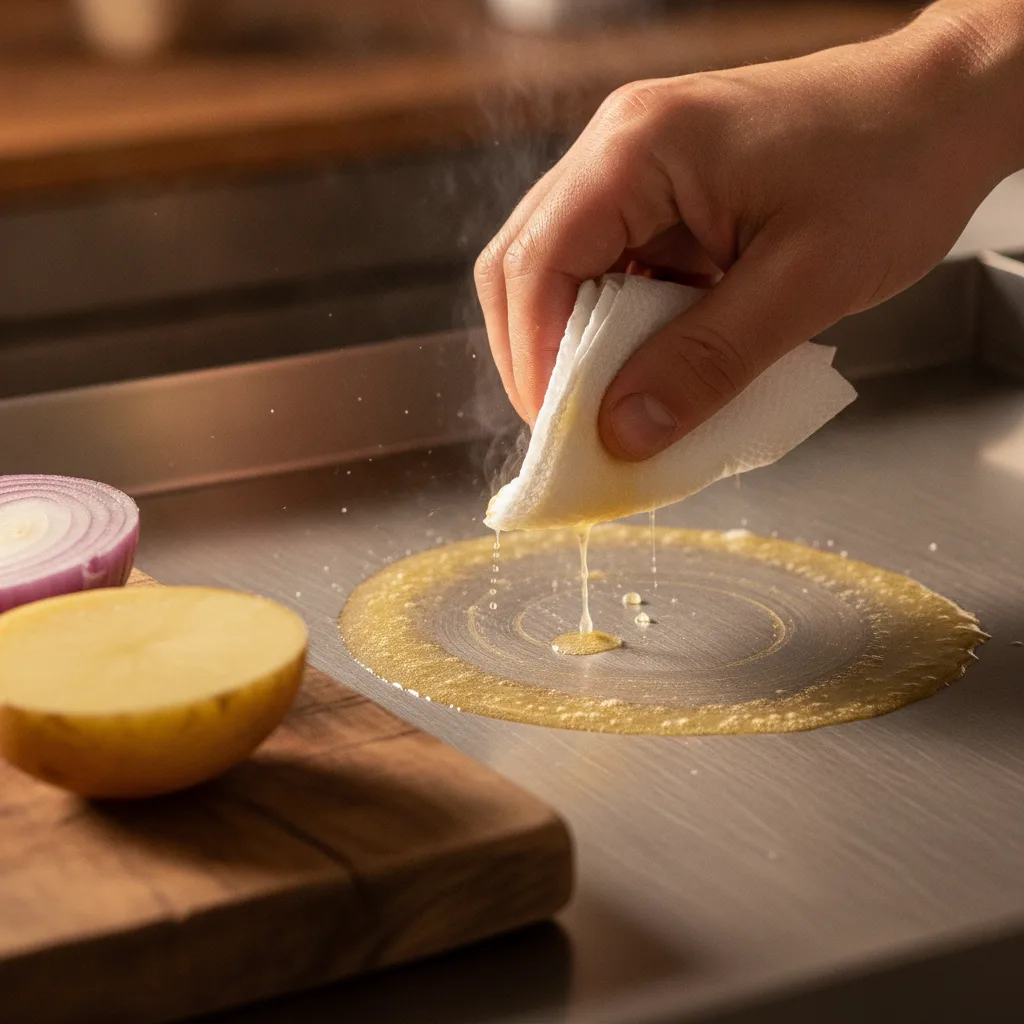
- Rub half an onion or a cut potato dipped in neutral oil over the hot plate, the traditional method of plancha cooks.
- Use a piece of kitchen paper soaked in clarified butter or sunflower oil, avoiding excess, which would fry the batter rather than cook it.
Key takeaway
A stainless steel plancha takes some getting used to. After three or four uses with careful seasoning, the surface becomes much less sticky and the crêpes flip easily with a flexible spatula.
Why use an electric plancha for crêpes?
The electric plancha is particularly well suited to crêpes. Its precise thermostat keeps the temperature stable throughout cooking, and this even heat is essential for crêpes, which need constant heat. It can be used both indoors and outdoors, which makes it very versatile.
At Planchaelec, we offer stainless steel electric planchas made in France, with smooth cooking surfaces and adjustable thermostats that are perfect for cooking crêpes. You can browse our range of electric planchas to find the model that suits your needs, whether you cook for 4 or for 12 people.
For cooking at home, the article on using a plancha indoors without smoke will also give you useful pointers on ventilation and temperature.
What plancha size is enough to make several crêpes at once?
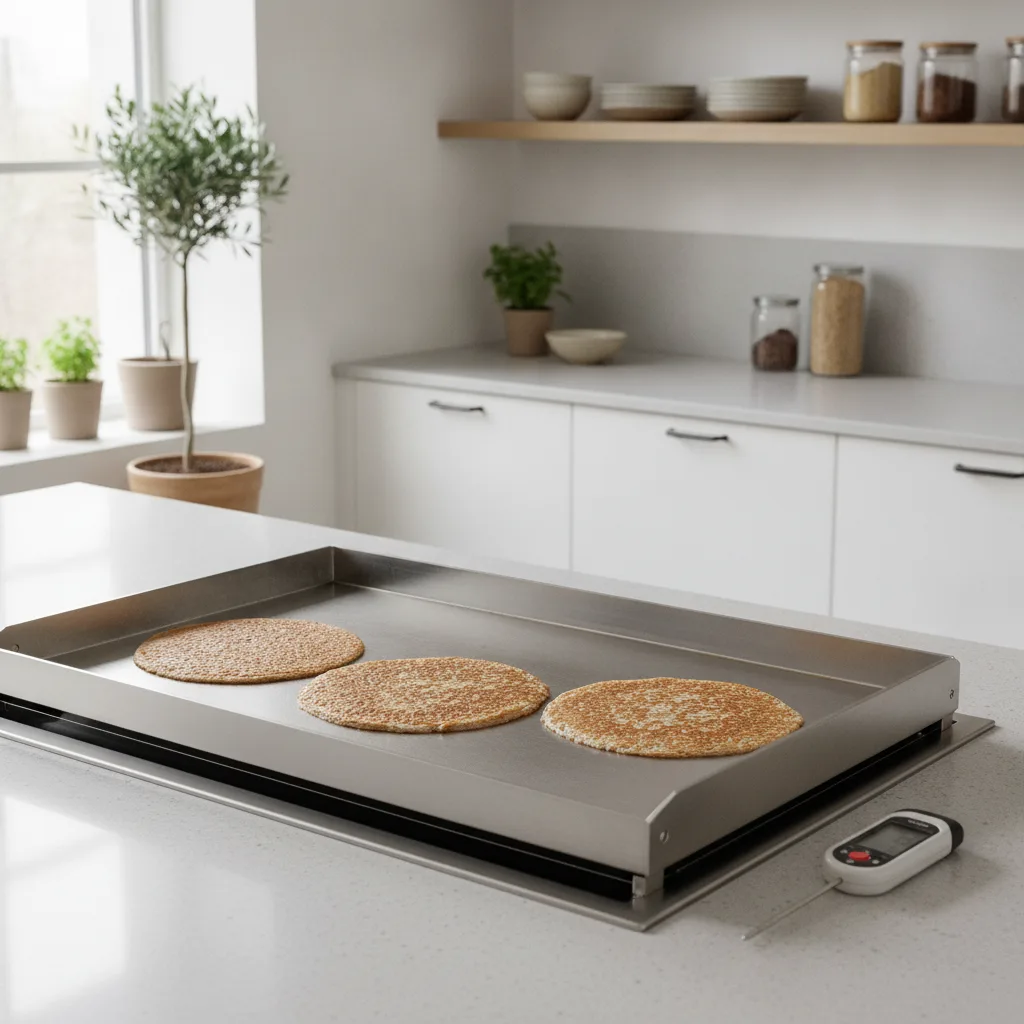
A classic crêpe measures about 25 to 28 cm in diameter. On a 40 cm wide plancha, you can comfortably cook one at a time, with room to handle the spatula. On a 60 cm plancha, two crêpes fit side by side without any problem. On large 83 cm models, three crêpes at once is quite feasible.
For a family meal for 4 to 6 people, a 60 cm plancha offers a good balance between usable surface and footprint. For a large table of 10 people or more, an 83 cm model significantly reduces serving time. Our dedicated article on how to choose the right plancha size for 10 people will give you precise pointers depending on the type of meal.
Heating zones also need to be taken into account: some electric plancha models have two independent zones, so you can cook crêpes at around 190 °C on one side while the other zone, set lower, keeps the finished crêpes warm.
Practical guide: making crêpes on the plancha step by step
The basic recipe doesn't change whatever the appliance. For about 15 crêpes, mix 250 g of flour, 3 eggs, 500 ml of milk, a pinch of salt and 30 g of melted butter. Leave the batter to rest for at least an hour in the fridge so that the gluten relaxes and the crêpes are more supple.
Preheat your plancha for 8 to 10 minutes, then lightly grease the surface. Pour a ladle of batter into the centre of the cooking area and spread it quickly with a crêpe spreader or the back of the ladle in a circular motion. The batter should cover an even area without holes. Cook until the edges lift, then slide a flexible spatula under the crêpe and flip it in one confident movement. The second side cooks for half as long as the first.
For cleaning after your crêpe session, wait until the plancha is still lukewarm, then pour on a little water to loosen the residue by deglazing. Wipe with a clean cloth and apply a light film of oil to protect the plate until the next use. Our complete guide to cleaning a stainless steel plancha details every step to keep your plate in good condition over time.
To complete your equipment, the range ofPlanchaelec utensils includes scraper spatulas, serving spatulas and abrasive pads suitable for cleaning stainless steel, all designed not to scratch the cooking surface.
Key points for your plancha crêpes
Making crêpes on the plancha is perfectly possible, and even enjoyable once you have mastered the two key factors: the temperature and greasing of the plate. A stainless steel plancha won't replace a competition-grade Breton crêpe maker for ultra-thin lace crêpes, but it far outperforms a standard crêpe maker when it comes to cooking in large quantities, in a convivial way, and varying between sweet crêpes, buckwheat galettes and other dishes. With an electric model fitted with a precise thermostat and a smooth, well-seasoned plate, you'll get consistent, delicious results, whether for Pancake Day or an ordinary Sunday.
FAQ
Can you make buckwheat galettes on a stainless steel plancha?
Yes, buckwheat galettes cook very well on a stainless steel plancha. Buckwheat batter is thicker and more rustic than wheat crêpe batter, which makes it less prone to sticking. Set the temperature slightly higher, between 200 and 210 °C, and grease the plate well. The result is a golden galette with a slightly crispy crust at the edges, characteristic of the authentic Breton galette.
Should you use butter or oil to grease the plancha before making crêpes?
Clarified butter (ghee) is often recommended because it withstands heat better than ordinary butter and gives crêpes a pleasant flavour. Sunflower oil or coconut oil also work very well. The important thing is to use only a very thin layer: too much fat fries the batter instead of cooking it flat, which changes the texture of the crêpe.
How long should you preheat an electric plancha before making crêpes?
Preheating for 8 to 10 minutes is generally enough for an electric plancha to reach a stable, even temperature across the whole surface. Preheating for too short a time leaves cold spots that make the batter stick. You can check that the temperature has been reached by pouring on a drop of water: if it evaporates immediately, the plate is ready.
Can you use an electric plancha indoors to make crêpes?
Yes, an electric plancha can be used indoors as long as the room is well ventilated. Cooking crêpes produces little smoke if the temperature stays around 180 to 190 °C and greasing is moderate. Our article onusing a plancha indoors without smoke gives you all the advice you need to enjoy your plancha at home with complete peace of mind.
What is the difference between an electric plancha and a traditional crêpe maker?
A traditional crêpe maker is a specialised appliance, optimised for thin crêpes and Breton galettes, with a circular plate of 30 to 40 cm and a thermostat calibrated for this type of cooking. An electric plancha is a versatile appliance with a much larger rectangular surface, suited to many dishes. The crêpe maker excels in precision for very thin crêpes, while the plancha wins on capacity and versatility for convivial meals.