



 +33 4 78 55 45 69
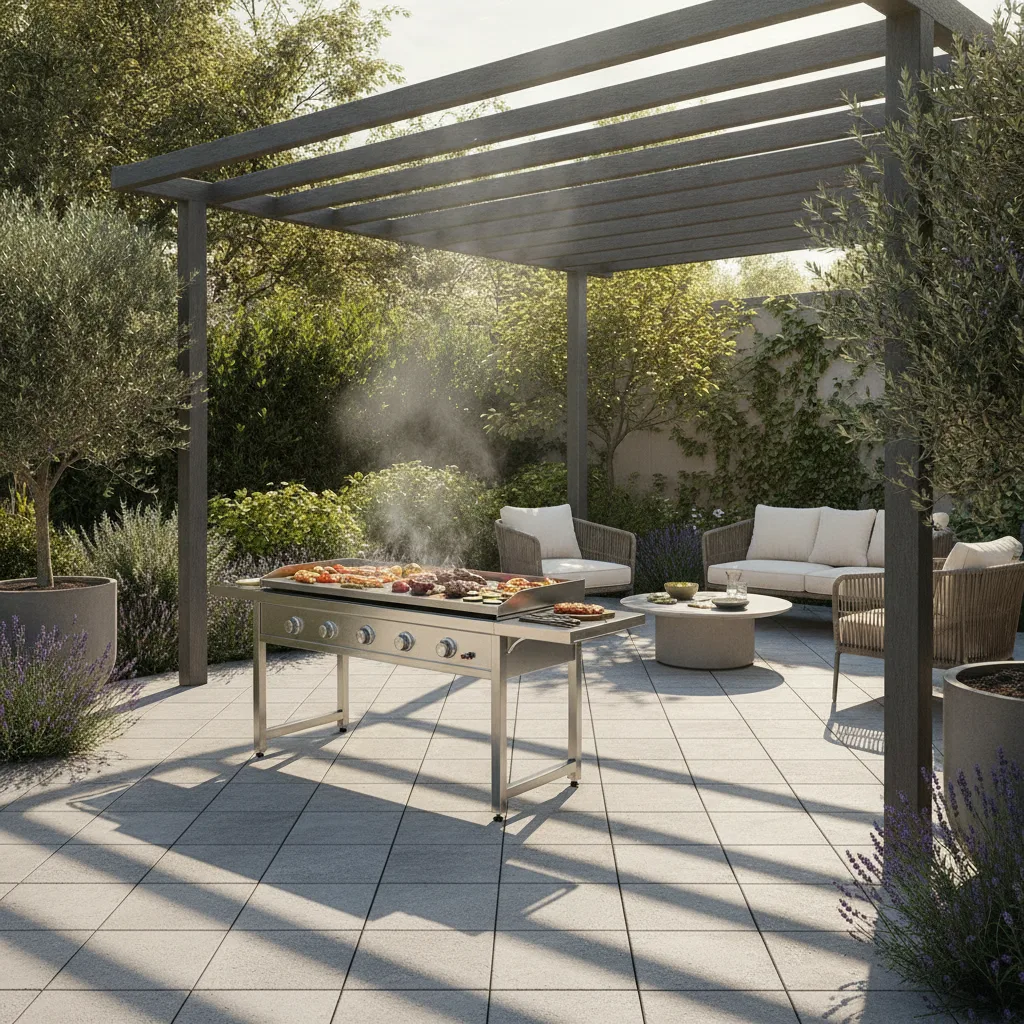
Setting up an outdoor kitchen with a plancha under a pergola means gaining shade, comfort and a longer cooking season. It also means concentrating heat, steam and grease splashes under a structure that was not always designed for it.
At Planchaelec, we make stainless steel electric planchas in France, and every spring we receive the same questions from customers fitting out their terrace. Here are the rules to know, the layouts that work and the mistakes that come up most often.
Outdoor kitchen with a plancha under a pergola: 2027 guide
Reading time: ~9 min
- Why a pergola changes the rules above a plancha
- What minimum distance to keep between the plancha and the roof
- Ensuring sufficient ventilation under a pergola
- Gas or electric plancha under a shelter: what really changes
- Which pergola and worktop materials to choose
- Three typical layouts for installing a plancha under cover
- Do you need permission for a covered outdoor kitchen?
- The most common safety mistakes
- Maintaining everything so it lasts
- Frequently asked questions
- Going further with a successful outdoor kitchen
Why a pergola changes the rules above a plancha
In the open air, heat and smoke rise and disperse. Under a cover, they hit an obstacle, spread horizontally and stagnate if there is not enough air flowing in from the sides. This applies as much to a bioclimatic pergola with closed adjustable louvres as to a fixed, watertight polycarbonate or aluminium roof.
The greasy vapours from cooking then settle on the louvres, fabrics and posts, where they form a film that is hard to remove and, on some materials, potentially flammable.
The second consequence is aesthetic and hygienic. A fabric canopy stretched above a cooking area quickly becomes impregnated and is hard to clean. An untreated wooden structure turns black and absorbs grease splashes. Powder-coated aluminium, on the other hand, can be cleaned with soapy water and no abrasive products, making it the most forgiving material for a covered outdoor kitchen.
What minimum distance to keep between the plancha and the roof
There is no universal distance that applies to every appliance. The only binding reference is the plancha manufacturer's technical manual, which specifies the clearances to respect above and around the appliance. Some general safety recommendations advise keeping up to 3 metres between a cooking appliance and a building, tree or flammable structure, but these values mainly concern solid-fuel barbecues and appliances with a naked flame.
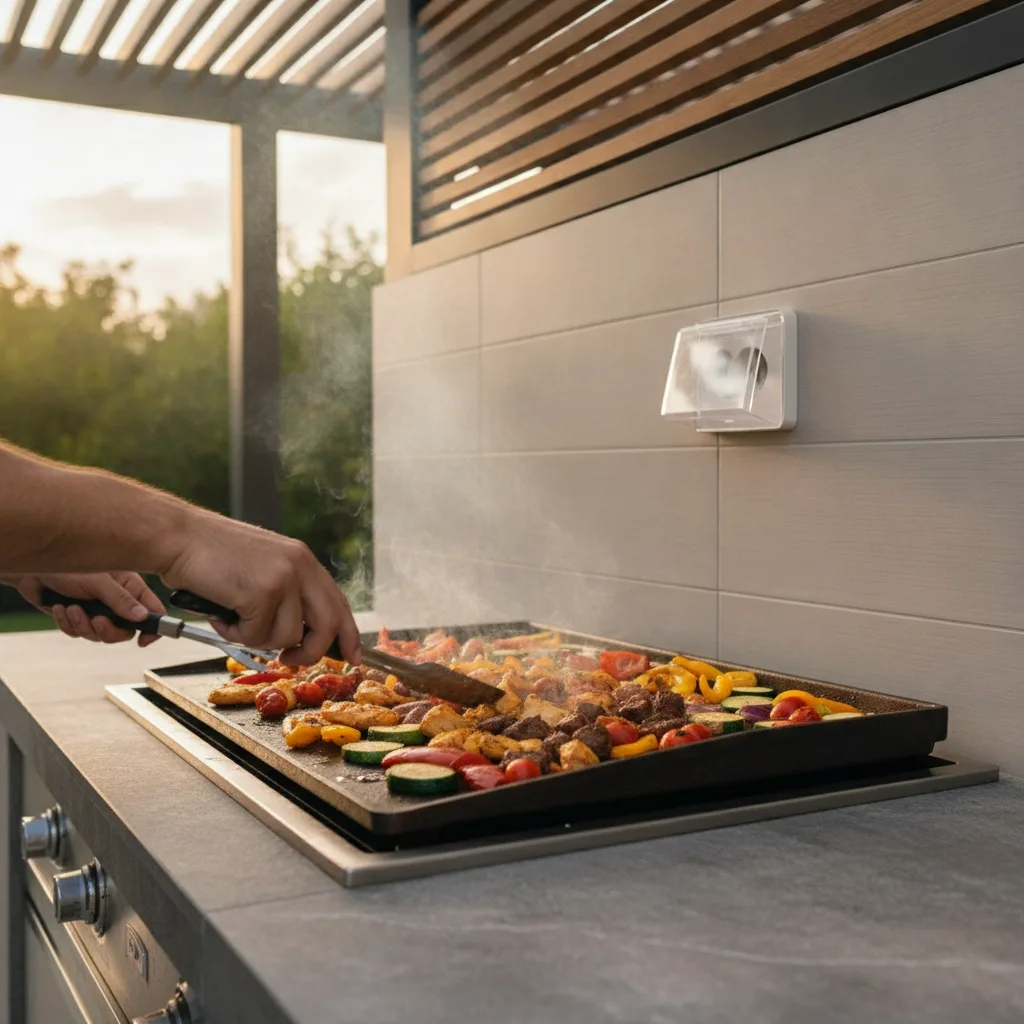
In practice, for a stainless steel electric plancha on a trolley, we use three guidelines. First, a comfortable clear height between the plate and the cover, ideally more than 1.80 metres, so that steam dilutes before it reaches the roof. Next, a side clearance of at least 50 centimetres between the edges of the plancha and any post, wall or partition, to preserve air circulation and limit deposits. Finally, no combustible material, fabric, reed screen or raw wood, directly in line with splashes.
Good to know
If your pergola is low or closed on two sides, a stainless steel wall splashback placed behind the cooking area effectively protects the wall or cladding from grease splashes and can be cleaned in seconds.
Ensuring sufficient ventilation under a pergola
How natural ventilation works under a pergola
Natural ventilation is based on a simple principle: fresh air comes in low down and from the sides, while hot air escapes through the top or the side openings. A pergola fully enclosed by vertical blinds, sliding glass panels and a watertight roof no longer plays this role. In that case, it is comparable to an enclosed space, with all the consequences that implies for extracting smoke.
To keep ventilation adequate, keep at least two sides open while cooking, set the louvres of a bioclimatic pergola to the open position before switching on the appliance, and avoid placing the plancha in a closed corner. If you cook under a fixed roof, move the cooking area towards the edge of the structure rather than its centre, so that steam escapes by the shortest route. A cooking lid also limits the spread of smoke and smells, while speeding up the cooking of thick pieces.
Gas or electric plancha under a shelter: what really changes
The choice of energy matters as soon as a cover is involved. A gas appliance works by combustion and produces combustion gases that must be evacuated, which requires very generous ventilation and rules out any use in an enclosed or poorly ventilated space. An electric appliance produces no combustion, but requires a connection protected against moisture.
| Criterion | Gas plancha under a pergola | Electric plancha under a pergola |
|---|---|---|
| Smoke extraction | Cooking fumes and combustion gases, very generous ventilation required | Cooking steam only, side ventilation sufficient |
| Connection | Hose and regulator to check, bottle stored upright outside any closed cabinet | IP44 waterproof socket with flap, earthed, circuit compliant with French standard NF C 15-100 |
| Use under a closed shelter | Not recommended, or even prohibited according to the manual | Possible if the shelter remains ventilated and the wiring protected |
| Routine maintenance | Burners, injectors, hose with expiry date | Stainless steel plate, grease tray, power cord and base |
| Installation constraints | Wider safety distance, fuel storage | Close to a protected power supply |
For an outdoor electric plancha under a shelter, the rule is clear. Use a waterproof socket with a flap rated at least IP44, earthed, on a circuit sized for the appliance's power and compliant with standard NF C 15-100. Avoid household extension leads unrolled across a damp terrace. Our Lux 600 and Lux 830 models, like the Néo range, are designed for outdoor use on a trolley, provided the cord and socket stay away from run-off areas and splashes.
Which pergola and worktop materials to choose
Powder-coated aluminium remains the benchmark for an outdoor kitchen pergola, thanks to its resistance to moisture, low maintenance and the possibility of integrating lighting, gutters and motorised controls. A powder-coated aluminium structure can generally be cleaned once or twice a year with soapy water, without abrasive products. It can, however, get hot in the sun depending on its colour and orientation.
Wood blends more warmly into a garden, but it needs periodic water-repellent treatment and must be kept well away from the cooking area. Fabrics and reed screens are the least suitable above a plancha, as they absorb greasy vapours and are hard to clean.
For the worktop, aim for a stable, flat, heat-resistant surface. Outdoor food-grade stainless steel is the most logical choice next to a stainless steel plancha: easy to degrease and unaffected by temperature changes, even if it shows fingerprints. Natural stone and porcelain stoneware are highly resistant to stains and weather, but their weight requires a properly sized supporting structure. Polished concrete can be customised but may crack in frost. Finally, wood should never be used as a direct support for the appliance without suitable protection.
Three typical layouts for installing a plancha under cover
Linear, L-shaped and U-shaped layouts
The linear layout suits narrow terraces. The plancha sits at one end, on the open side of the pergola, followed by the preparation surface and then storage. The steam goes outwards and does not cross the living area.
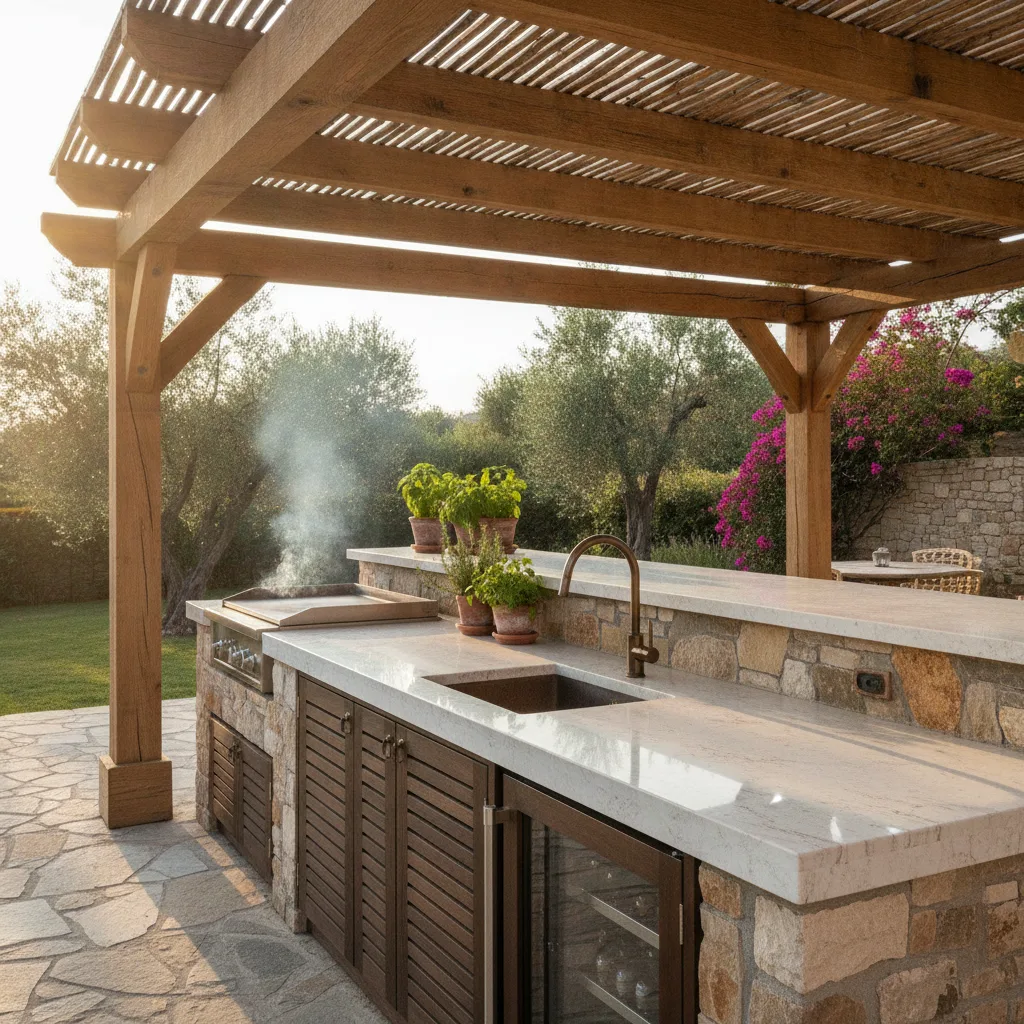
The L-shaped layout clearly separates the cooking area from the preparation area, with the plancha on the arm most exposed to the open air and the sink on the sheltered arm. The U-shaped layout offers the most storage, but it is also the most demanding in terms of ventilation, as it encloses the cook and the steam in a semi-enclosed space.
In all three cases, keep the guests' table at least 1.50 metres from the cooking area and leave a clear passage around the appliance.
Do you need permission for a covered outdoor kitchen?
It all depends on the area created and the type of installation. In France, as a general rule, a covered outdoor structure of less than 5 m² requires no formalities outside protected areas, between 5 and 20 m² a prior declaration of works is generally required, and above 20 m² a building permit may be required under the French Town Planning Code. These thresholds vary according to the exact nature of the project (pergola, covered terrace, annex or simple mobile equipment) and the requirements of the local urban development plan (PLU). Outside France, check the rules that apply where you live.
Important
Near a historic monument or in a heritage area, the opinion of the Architecte des Bâtiments de France (heritage architect) may be required, with constraints on colours and materials. Always check your project with your local town hall's planning department before starting work.
The most common safety mistakes
Most of the incidents reported come down to simple oversights, often linked to the rush at the start of the season. Here are the ones we come across most often among users fitting out a summer kitchen with a plancha.
- Switching on the appliance with the pergola louvres closed, which traps heat and smoke under the cover.
- Plugging the plancha into an indoor socket via an extension lead on the floor, with no protection against moisture and no earth.
- Setting up the cooking area under a tree, which accumulates resin, leaves and dry branches above a heat source.
- Placing the appliance on unprotected wooden furniture or an unstable surface.
- Forgetting to empty the grease tray, which overflows and turns the terrace into a slippery surface.
- Storing a still-warm plancha under a non-breathable cover, which encourages condensation and marks on the stainless steel.
A fire blanket or extinguisher within two steps of the cooking area remains the simplest precaution to put in place. Also think about rainwater drainage, so that the pergola's gutters do not empty onto the appliance or the walkway.
Maintaining everything so it lasts
Maintaining the plancha and the structure
A covered installation ages well if it is properly maintained. For the plancha, let the plate cool to lukewarm, scrape off residue with the spatula, degrease with a suitable product, empty and wash the grease tray, then dry before fitting a breathable protective cover.
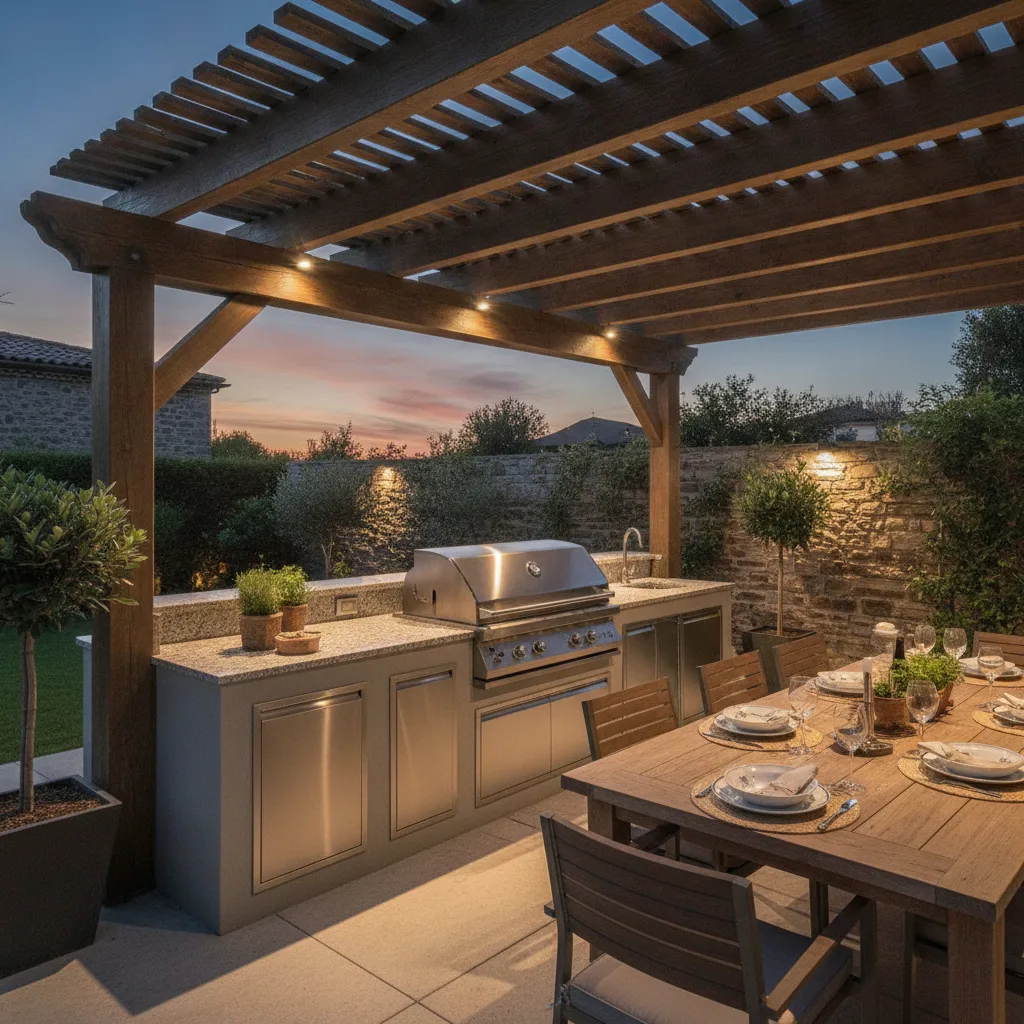
For the structure, clean the louvres and posts with soapy water, check the fixings once a year, clear the gutters in autumn and test the motorised louvre mechanism before winter. Our cleaning accessories and covers are sized for each plancha and trolley format, which avoids makeshift solutions.
FAQ – frequently asked questions
Does a bioclimatic pergola really protect the plancha from rain?
Partly. With the louvres closed, it greatly limits water ingress, but watertightness depends on the model, the quality of the seals and the drainage system. In heavy sideways rain, a cover is still needed to protect the appliance when not in use.
Can an electric plancha be left outside under a pergola all year round?
The appliance is suitable for outdoor use, but prolonged storage in damp conditions wears out the connectors and knobs. We recommend a suitable cover and, in winter, storing the appliance, or at least the power cord, in a dry place.
What minimum pergola height should you plan for comfortable cooking?
A height under the beam of 2.20 to 2.50 metres is generally comfortable for daily use. Below 2 metres, the heat you feel increases significantly and grease deposits on the cover build up faster.
Is lighting mandatory above the cooking area?
It is not mandatory, but strongly recommended for cooking safely in the evening. Choose a light fitting rated for outdoor use, placed out of the direct path of the steam and connected to a circuit that complies with electrical installation rules.
Do you need to declare a removable pergola installed on an existing terrace?
A non-fixed, removable structure may not require a prior declaration, but this depends on local regulations. Your local urban development plan remains the source to consult before any installation.
Going further with a successful outdoor kitchen
A well-designed outdoor kitchen with a plancha under a pergola comes down to four decisions: the height and clearance under the cover, effective ventilation while cooking, the type of materials exposed to grease and the quality of the connections.
A stainless steel electric plancha greatly simplifies the equation, as it eliminates combustion and only needs a properly protected power supply. For the rest, the appliance manual and your local planning regulations remain your two reference documents.
In summary
By combining a suitable plancha, a well-sized pergola and a carefully planned layout for your outdoor kitchen with a plancha under a pergola, you can enjoy a comfortable, safe and durable space. Respecting safety distances, taking care of ventilation and maintaining everything regularly lets you cook outdoors more often, without damaging the structure or adding constraints.