



 +33 4 78 55 45 69
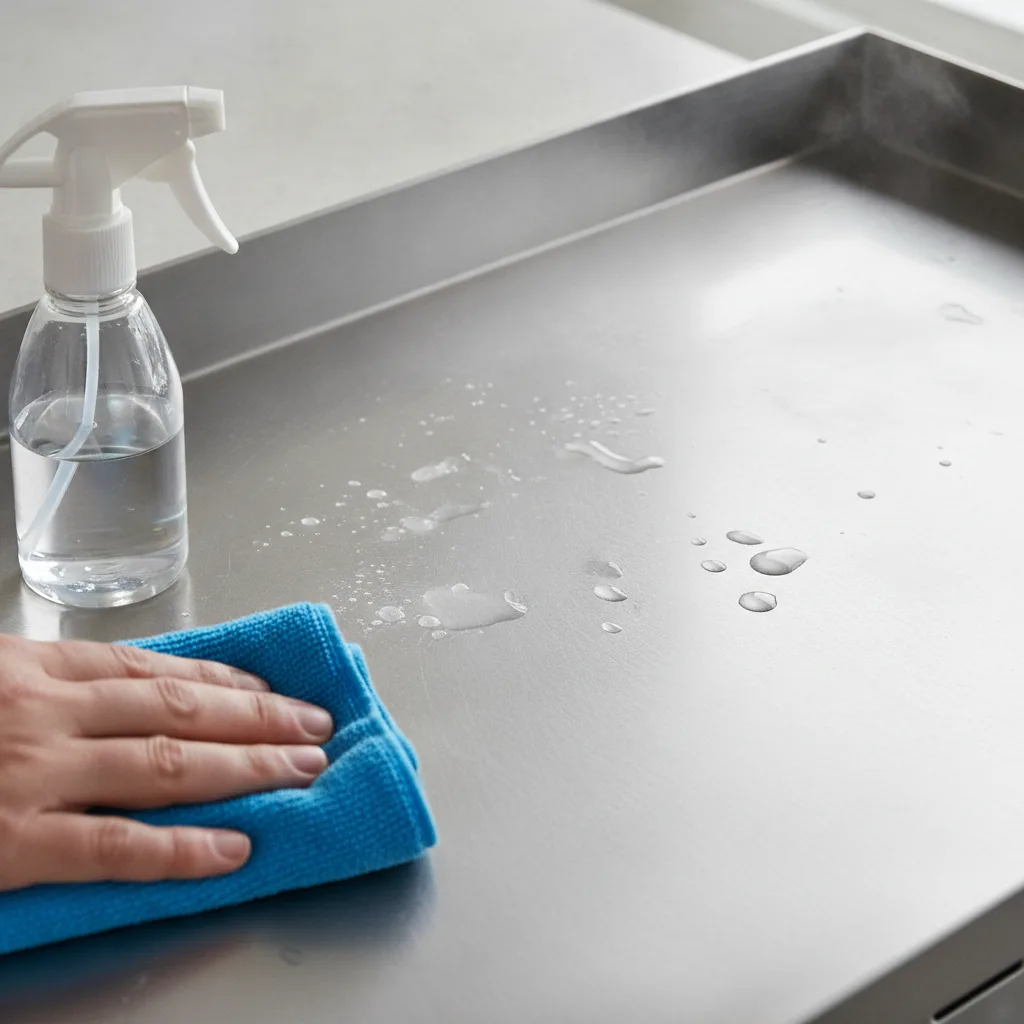
You have just cleaned your plate, it was spotless, and a few minutes later whitish films appear on the steel of your stainless steel plancha. This is neither an anomaly nor a manufacturing defect: these are simply limescale marks, minerals dissolved in your rinsing water that stay on the plate after it evaporates.
The good news is that these rings come off effortlessly with a gentle method and, above all, can be almost completely avoided with a ten-second habit. Here is the procedure we recommend to our customers to minimise the limescale marks left by water.
Limescale marks on a stainless steel plancha – 2027 guide
Reading time: ~8 min
- Why a stainless steel plancha keeps limescale marks from water
- The gentle method for removing limescale from a stainless steel plancha
- Which products to use and which to avoid
- Cleaning the plancha hot, lukewarm or cold
- Avoiding water marks on a stainless steel plancha every day
- How to keep a stainless steel plancha shiny in the long term
- In summary: stainless steel plancha and limescale marks
- FAQ – frequently asked questions about limescale and caring for a stainless steel plancha
Why a stainless steel plancha keeps limescale marks from water
Stainless steel, whether AISI 304 or AISI 316, is a smooth, non-porous surface. When a drop of water lands on it and then evaporates, the water goes but what it was carrying stays. The dissolved calcium and magnesium remain in place and form the whitish limescale deposit commonly known as a water ring.
The impact of hard water on limescale marks
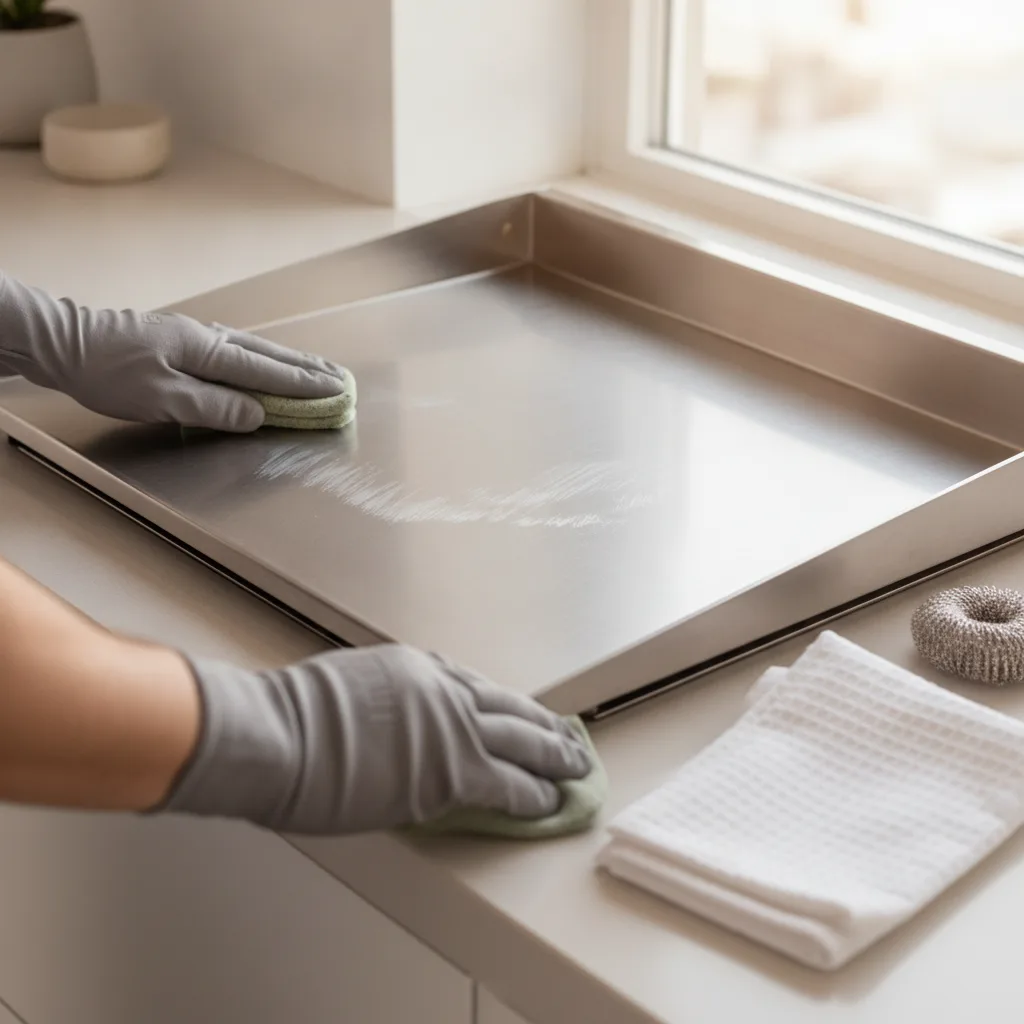
The harder your tap water, the more visible the phenomenon, especially on a horizontal cooking plate where water sits instead of running off. Residual heat speeds up the process: if you rinse a plate that is still warm, evaporation is almost instant and the minerals concentrate into clear marks. Poorly rinsed detergent residue produces a visually similar result, a dull film that catches the light.
In both cases, the phenomenon remains superficial. It does not attack the thin protective film of chromium oxide that gives the steel its resistance to corrosion. So you are dealing with a cosmetic problem, not damage to the material.
The gentle method for removing limescale from a stainless steel plancha
The principle is simple: a weak acid dissolves the limescale deposit without attacking the steel, as long as you do not leave it on too long and rinse properly. White vinegar, which is diluted acetic acid, is perfect for light rings. Citric acid powder diluted in lukewarm water gives an equivalent result and smells less.
Steps for removing limescale from a stainless steel plancha
Here is the complete procedure for descaling a stainless steel plancha without damaging it:
- Switch off the appliance, wait until the plate is lukewarm, never scorching, then remove the cooking residue with a suitable spatula, pushing it towards the drip tray.
- Prepare a diluted white vinegar solution: one part vinegar to one part water for heavy marks, one part to three parts water for light films.
- Soak a microfibre cloth or non-abrasive sponge, apply it to the limescale rings and leave for a few minutes without letting the solution dry on the plate.
- Rub gently following the direction of the stainless steel's brushing, an essential detail on a satin finish to keep an even appearance.
- Rinse thoroughly with clean water until the smell and product have completely gone.
- Dry immediately with a clean, dry microfibre cloth, without waiting for it to air-dry.
For old, encrusted deposits, occasional descaling with a cleaner designed for stainless steel or planchas remains the safest solution, strictly following the manufacturer's instructions and checking that the product is food-safe. Some professional recommendations mention diluted phosphoric acid for severe cases, but this should remain exceptional and be handled with care. In all cases, acid treatment should be localised and occasional, never routine.
Good to know
Descaling too often is counterproductive. If you dry the plate after each cleaning, you will only need a vinegar treatment two or three times a season.
Which products to use and which to avoid
Not all stainless steel plancha cleaning products are equal on a stainless steel cooking plate. Some act on the surface, others weaken the material in the long term. The table below sums up what we recommend.
Recommended products and products to avoid on a stainless steel plancha
| Product | Recommended use | Precautions |
|---|---|---|
| Lukewarm water and mild washing-up liquid | Routine cleaning, light grease | Rinse until all soap is removed |
| Diluted white vinegar | Light limescale rings and marks | Never neat for long, rinse and dry |
| Diluted citric acid | Occasional limescale deposits | Moderate use, rinse thoroughly |
| Special stainless steel or plancha cleaner | Persistent deposits and baked-on grease | Follow the instructions, check it is food-safe |
| Demineralised water | Final rinse in very hard-water areas | Still dry with a microfibre cloth |
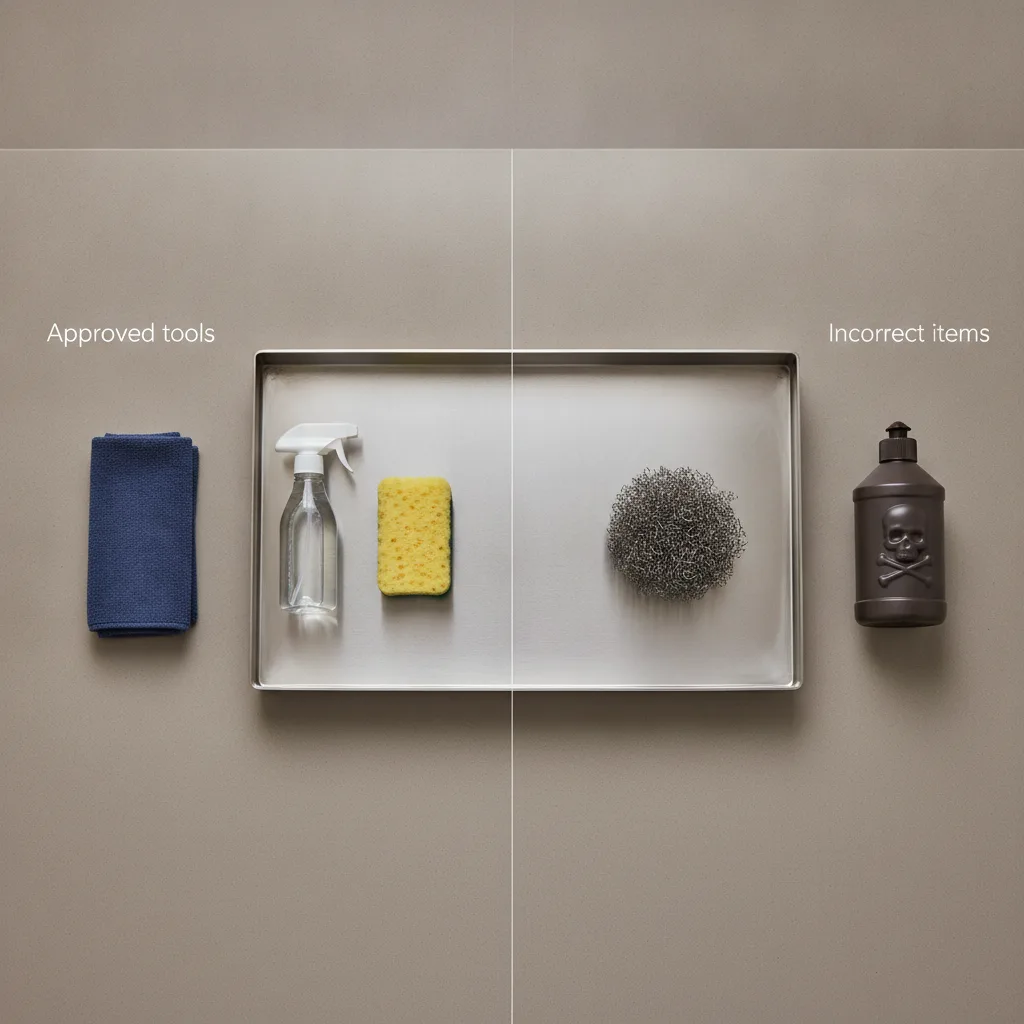
| Bleach and chlorinated products | Avoid | Risk of attacking the passive layer and causing corrosion |
| Hydrochloric, hydrofluoric, nitric acid | Avoid | Descalers too aggressive for a food contact plate |
| Steel wool, metal sponge | Avoid | Permanent scratches on the finish |
Above all, remember two prohibitions. First chlorine, because bleach and chlorinated cleaners can trigger pitting corrosion on stainless steel. Then metal abrasives, which create micro-scratches where grease and minerals will lodge, making the problem you were trying to solve worse. Scouring pads sold specifically for stainless steel planchas, used with their handle and in the direction of the brushing, are an exception because they are designed for this type of surface.
Cleaning the plancha hot, lukewarm or cold
This question comes up often. A stainless steel plancha is ideally cleaned after cooking while the plate is lukewarm, because the grease stays soft and comes off with a single pass of the spatula. On a cold plate, residue hardens and needs more rubbing. On a scorching plate, you risk injuring yourself and subjecting the material to thermal shock. For the most stubborn cases, our tutorial on how to clean a burnt stainless steel plancha explains the procedure.
Deglazing with water or ice cubes is a widespread practice that is effective for loosening cooking juices. Only consider it if your appliance's manual explicitly allows it, because splashing cold water onto a very hot sheet of metal can cause warping. Our planchas are designed with thick plates precisely to withstand temperature differences, but the rule remains the same: check first.
Once the residue has been scraped into the drip tray, a soft sponge, a compatible detergent, careful rinsing and immediate drying are all you need.
Avoiding water marks on a stainless steel plancha every day
Prevention is worth all the anti-limescale products in the world. Systematically wiping dry is the habit that changes everything, because without residual water there can be no mineral deposit. A few simple habits are enough to keep a stainless steel plancha clean and free of marks in the long term.
- Dry the whole plate with a microfibre cloth as soon as you finish rinsing, following the direction of the brushing, and do not forget the corners where water collects.
- If your water is very hard, keep a bottle of demineralised water for the final rinse; this significantly reduces rings.
- Protect the plate between uses with a lid or a suitable cover, which keeps off rain, dew and splashes.
Key point
A plancha that is cleaned regularly is quick to clean. It is the build-up of baked-on grease and layers of limescale that turns a two-minute job into a twenty-minute chore.
How to keep a stainless steel plancha shiny in the long term
A plate cared for in this way keeps its original appearance for years. Stainless steel does not develop a patina like cast iron; it keeps its finish as long as you do not scratch it or let water dry on it.
At Planchaelec, our plates are made of solid stainless steel manufactured in France, a choice that makes this care easier precisely because there is no fragile coating to protect. A dedicated degreasing cleaner, a non-abrasive sponge, a microfibre cloth and a quality spatula make up the complete kit, and our cleaning accessory packs bring these items together.
In summary: stainless steel plancha and limescale marks
White marks on a stainless steel plancha are therefore neither inevitable nor a sign of poor-quality material. They simply show that water has dried on the plate. Diluted white vinegar to correct them, thorough rinsing and immediate drying to stop them coming back: the routine comes down to three steps. If you are still unsure which model suits your use, our guide on stainless steel plate thickness explains this essential criterion, from power to thermal resistance.
FAQ – frequently asked questions about limescale and caring for a stainless steel plancha
Is bicarbonate of soda suitable for white marks on a stainless steel plancha?
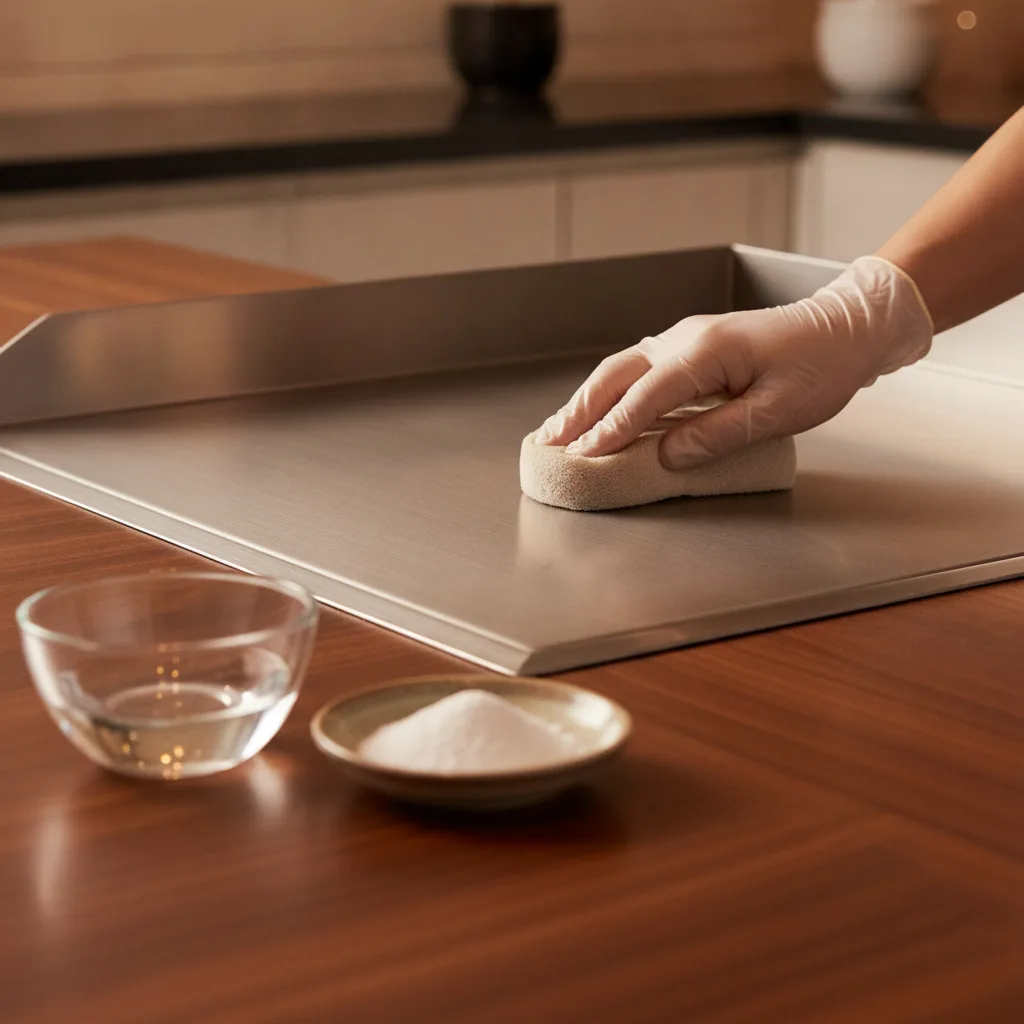
As a thick paste rubbed vigorously, bicarbonate becomes slightly abrasive and can mark a satin finish. If you really want to use it, dilute it well and use a soft sponge, but diluted white vinegar remains more effective on limescale because it works chemically rather than mechanically.
Can limescale damage the appliance's heating element or thermostat?
No, the deposit stays on the surface of the plate. However, water seeping towards the electrical components is a real risk. Never flood the plancha and keep the controls, cord and power base away from rinsing.
Should the plate be oiled after descaling?
A very thin film of neutral oil applied to a clean, dry plate before the next cooking session helps food release and limits residue sticking. It does not replace drying and should not be applied in a thick layer on a plancha stored for several weeks.
Are rainbow-coloured rings also limescale?
No, bluish or golden iridescence corresponds to normal thermal oxidation of stainless steel exposed to high temperatures. It is harmless and often fades with a stainless steel cleaner, but it is not a descaling issue.
How often should a stainless steel plancha be descaled?
There is no fixed schedule; it all depends on how hard your water is and how carefully you dry. A diluted vinegar treatment when white films become visible is enough, usually two to three times a season for family use.