



 +33 4 78 55 45 69
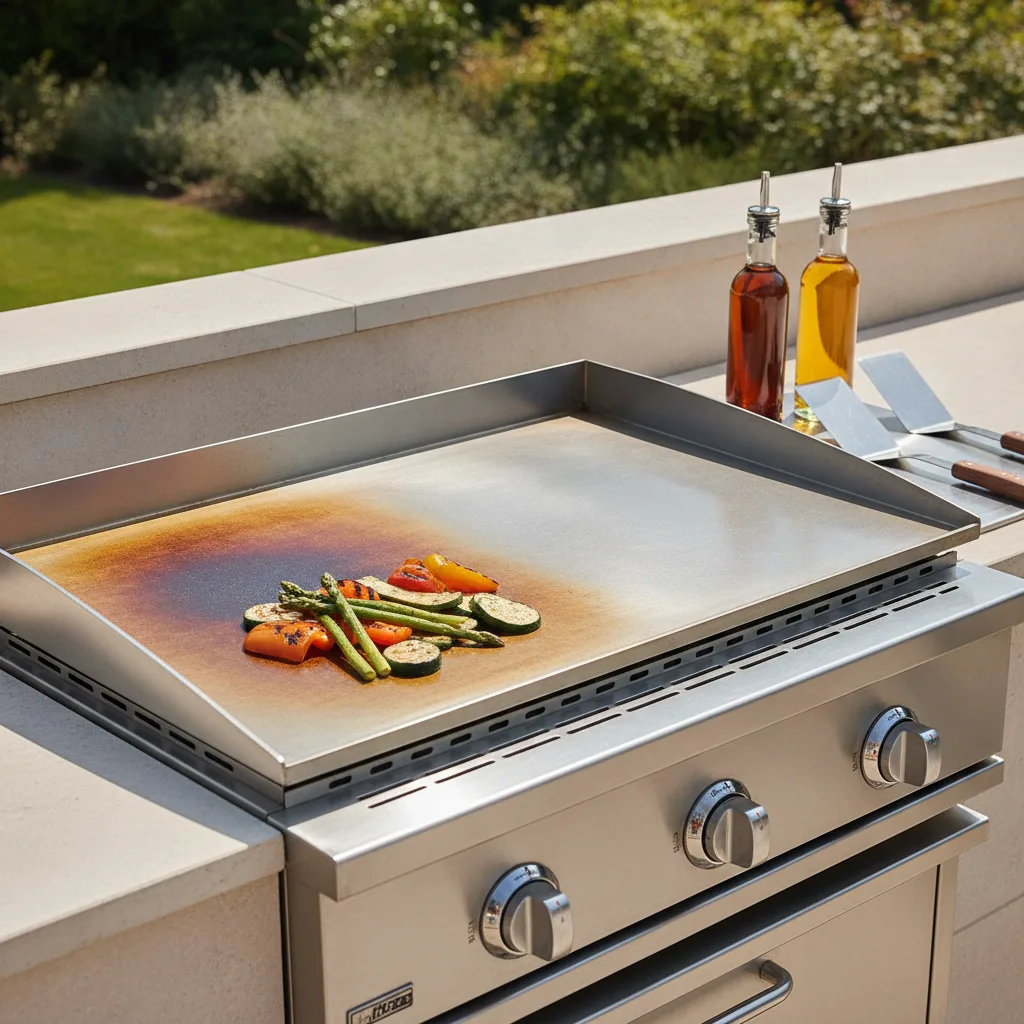
To season or not to season your stainless steel plancha: the question comes up every spring on outdoor cooking forums. Linseed oil is often presented as the miracle solution for a non-stick surface, while refined sunflower oil remains the most common recommendation from manufacturers.
We have gathered user feedback and manufacturers' recommendations to compare the two approaches over time, after 5, 10 and then 20 cooks. Here is what seasoning a stainless steel plancha with linseed oil generally achieves compared with a more traditional method, and how to oil your plate properly without creating sticky deposits.
Seasoning a Stainless Steel Plancha with Linseed Oil – the 2027 Guide
Reading time: ~8 min
- Seasoning, polymerisation and patina: what exactly are we talking about?
- Do you really need to season a new stainless steel plancha?
- Seasoning a stainless steel plancha with linseed oil: what happens over time
- The smoke point of linseed oil: a figure to handle with care
- Which oil for seasoning a stainless steel plancha?
- The right oiling method, step by step
- Why food still sticks to an oiled plate
- Caring for your stainless steel plancha after each use
- Going further with seasoning your stainless steel plancha
- Frequently asked questions about seasoning a stainless steel plancha
Seasoning, polymerisation and patina: what exactly are we talking about?
Understanding seasoning on stainless steel
Seasoning consists of heating a very thin layer of oil until it turns into a protective film bonded to the metal. This phenomenon has a precise name: oil polymerisation. Under the effect of heat and oxygen, the fatty acids reorganise and form a hard polymerised layer, which limits food sticking and protects the surface from oxidation.
The Swedish reference Skottsberg points out that this process aims first and foremost to create a protective and relatively non-stick layer, not a permanent, indestructible one.
This mechanism works remarkably well on cast iron and carbon steel, whose porous, slightly rough surface mechanically holds the patina. Stainless steel is in a different category. The grades commonly used for planchas, mainly 430 and 304 stainless steel, have a dense, smooth surface passivated by a chromium oxide layer. This layer protects the metal from corrosion, which is its great advantage, but it offers little grip to a polymerised film. That is the whole nuance of the stainless steel versus carbon steel seasoning debate.
Do you really need to season a new stainless steel plancha?
Cleaning a new stainless steel plancha before use
The honest answer is no, not in the strict sense. On a stainless steel plancha, the priority on first use is the initial cleaning, not building a crust. Manufacturing residue, fingerprints, transport dust and traces of washing-up liquid must be removed before the first heating. Washing with hot water and a mild detergent, rinsing thoroughly and drying carefully is enough.
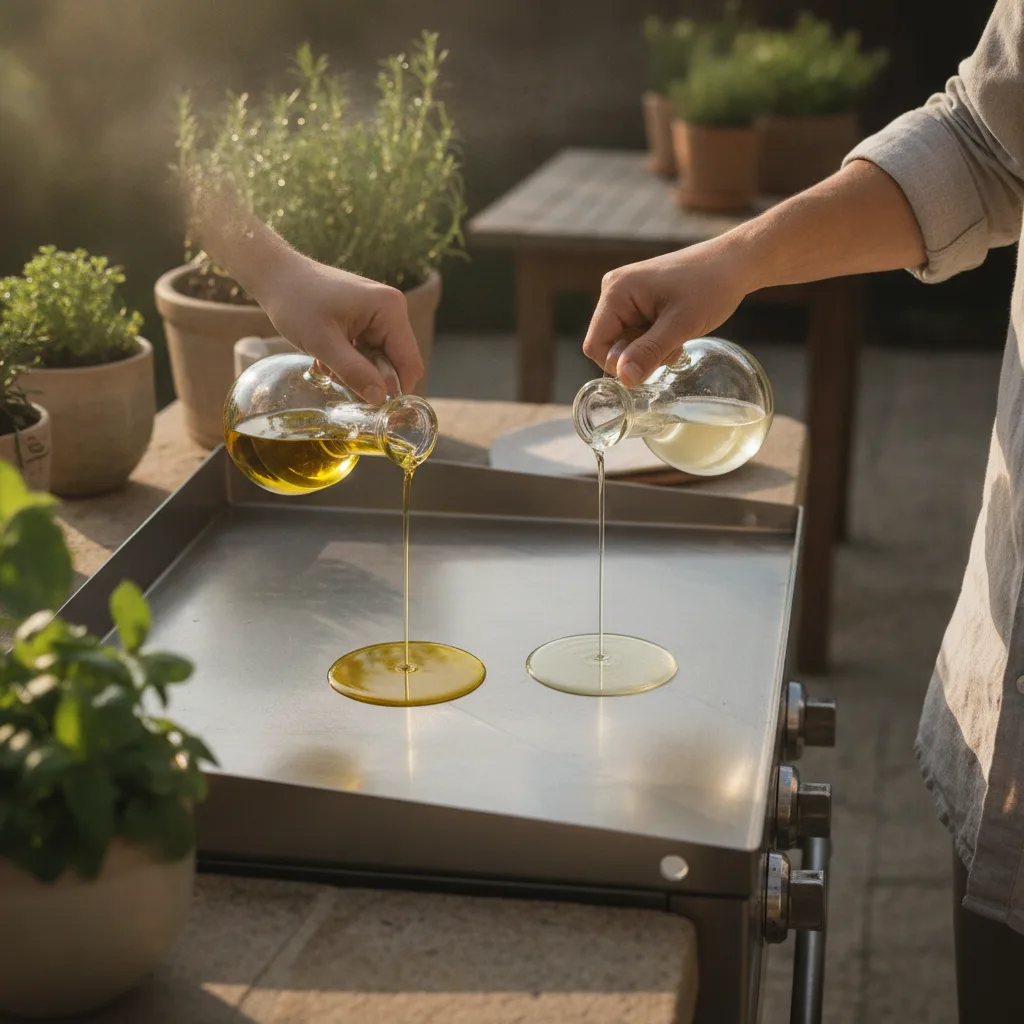
Several manufacturers of stainless steel electric planchas confirm this: a simple film of oil applied before each cook reduces sticking satisfactorily, without requiring seasoning comparable to that of a rolled steel plate.
This does not mean oiling is pointless. Oiling the stainless steel plancha before cooking remains a key step, but its logic is different. You are not building a durable patina, you are laying down a temporary greasy interface between the food's proteins and the metal. This distinction changes everything in the choice of oil and how to apply it.
Good to know
Any oil intended to come into contact with a cooking surface must be food grade, in accordance with regulations on materials in contact with food. Technical linseed oil sold in DIY stores for wood never falls into this category.
Seasoning a stainless steel plancha with linseed oil: what happens over time
What user feedback shows
Take two identical stainless steel plates. The first receives three coats of food-grade linseed oil, applied with a cloth in an almost invisible layer, with a gradual rise in temperature and complete cooling between each coat. The second is simply cleaned, dried and then oiled with refined sunflower oil before each cook.
After 5 uses, the difference is visible. The plate treated with linseed oil has an even amber tint and noticeable non-stick behaviour with fish fillets, traditionally the most delicate. The control plate needs a little more fat when the food is placed on it, but the result on the plate is identical.
After 10 uses, the trend partly reverses. The linseed film starts to flake unevenly in the hottest areas, in the centre of the cooking surface, where the plancha scraper passes most often. The edges, less exposed, keep their patina. This contrast creates an uneven surface, harder to clean than expected, with some charred residue trapped at the edge of the patina.
After 20 uses, the control plate is the more even of the two. It has developed a slight natural colouring, due to heating cycles and cooking juices, but its surface remains smooth and can be cleaned with hot water and a dedicated pad. The linseed-seasoned plate often has to be stripped and started again from scratch. In short: on stainless steel, intensive seasoning with linseed oil brings a real benefit in the first weeks, then becomes a maintenance burden.
The smoke point of linseed oil: a figure to handle with care
This is the most confusing point in the available literature. Some culinary sources put the smoke point of linseed oil at around 107 degrees and clearly advise against heating it strongly. Other sources specialising in seasoning give a value close to 230 degrees for food-grade linseed oil. This discrepancy is explained by the degree of refining, the freshness of the product and the measurement method.
We therefore do not adopt any single value. A quality electric plancha easily reaches 250 to 300 degrees on its cooking surface, well beyond the comfort zone of a standard food-grade linseed oil.
What makes linseed oil effective for seasoning is its drying power, measured by the iodine value, the highest of common edible oils. It is a drying oil: it dries and hardens. This same property explains its thermal fragility. The nutritional value of raw linseed oil, rich in omega-3, lies precisely in the fact that it is sensitive to heat and oxidation.
Which oil for seasoning a stainless steel plancha?
The table below summarises these observations and the most consistent recommendations from professionals.
| Oil | Behaviour on stainless steel | Recommended use |
|---|---|---|
| Refined sunflower | Stable at high temperature, even film, easy cleaning | Oiling before each cook and routine care |
| Grapeseed | Very good heat resistance, neutral taste | Premium alternative for everyday cooking |
| Food-grade linseed | Quick patina but uneven flaking over time | Occasional use, for experienced users only |
| Extra virgin olive | Smokes early, leaves brown residue and a sticky deposit | Keep it for seasoning at the end of cooking |
| Technical linseed | Not food grade | Never use |
To answer a frequent question directly: yes, you can use olive oil on a stainless steel plancha, but not to oil the plate before strong heating. Its low smoke point generates smoke and residue. Instead, drizzle it over the food when serving.
The right oiling method, step by step
Technique matters as much as the product chosen. Here is the sequence we apply to our plates, from first switch-on to cooking.
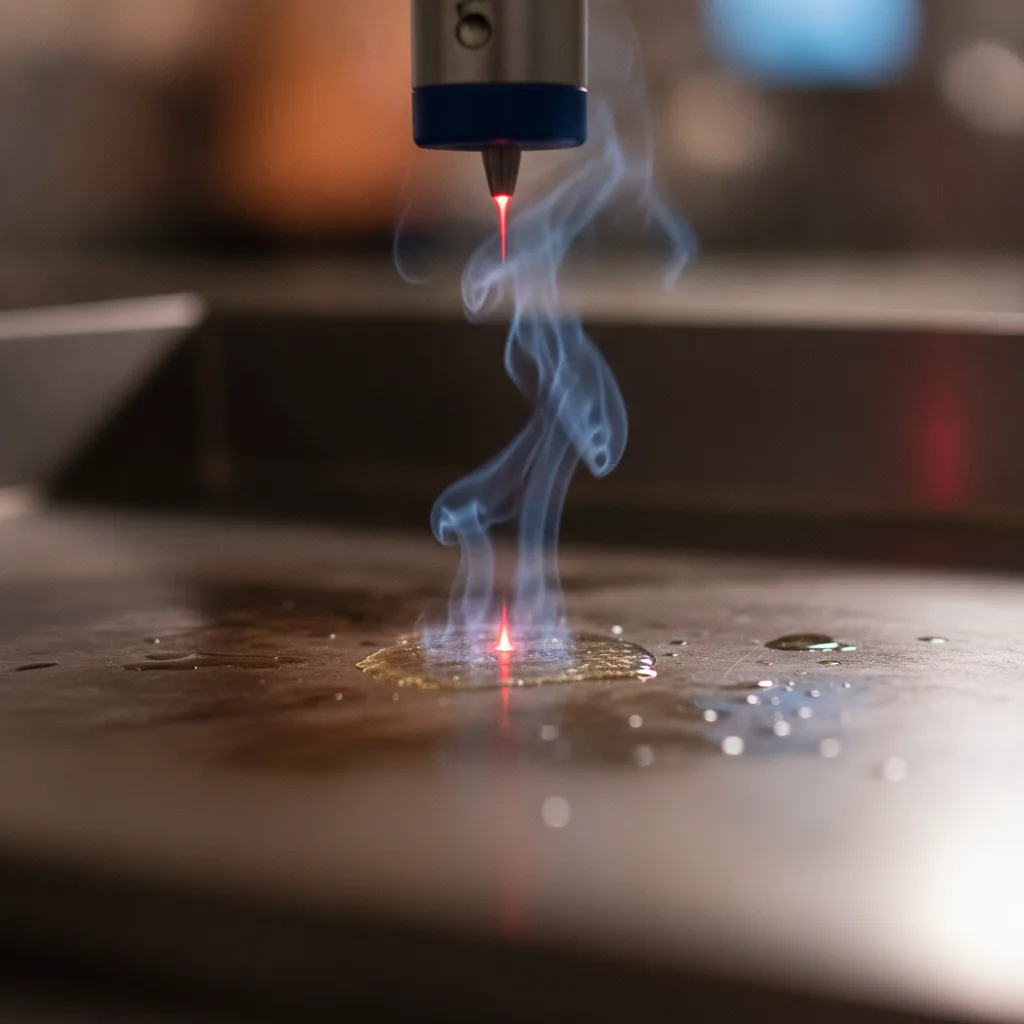
- Wash the cold plate with hot water and a mild detergent, rinse thoroughly and dry completely.
- Raise the temperature gradually, without thermal shock, to medium heat.
- Put a few drops of oil on kitchen paper and spread them in an almost invisible layer: the surface should look satin, not shiny with puddles.
- Let it heat briefly until a light haze of smoke appears, without ever letting the oil burn.
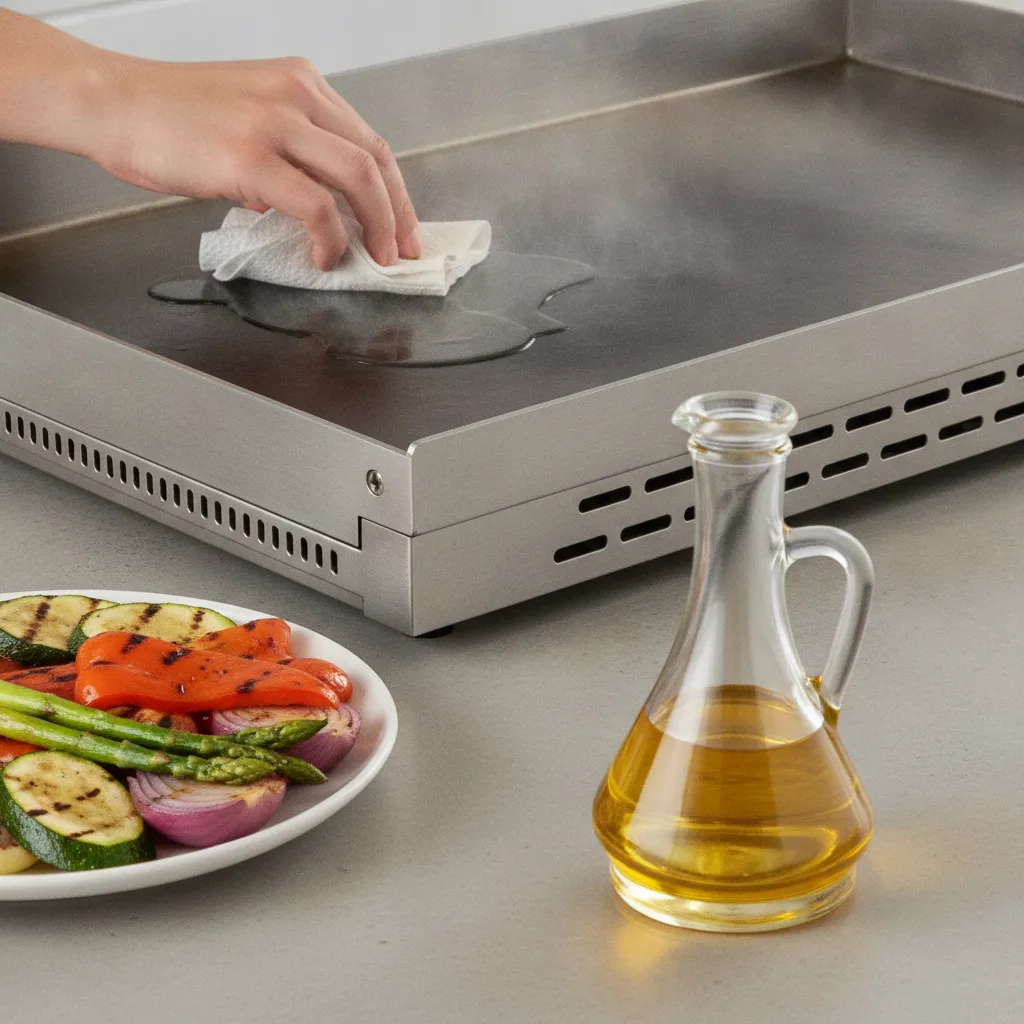
- Wipe off the excess once the plate is lukewarm, so as to leave no thick greasy film.
Important
An oil layer that is too thick is the leading cause of sticky deposits and irregular brown stains. The less you use, the better the result.
Why food still sticks to an oiled plate
Three causes explain almost all cases. The first is a plate that is not hot enough when the food is placed on it, which prevents searing and lets the proteins bond to the metal. The second is food that is too wet or straight out of the fridge, which suddenly cools the contact zone. The third is trying to turn the food too early, before the crust has formed.
A properly seared piece releases by itself. Our detailed plancha cooking tips cover these points in detail.
Caring for your stainless steel plancha after each use
After-cooking care routine
Routine care determines the lifespan of the surface far more than the initial seasoning. Scrape off residue with a scraper while the plate is still hot, pour a little water to loosen the juices without ever flooding a scorching plate, then wipe. Dry carefully to avoid mineral marks from limescale.
A very thin film of oil before storing protects the surface, provided you wait until it has cooled completely before putting on a cover or closing a lid. Our complete guide to caring for a stainless steel plancha details each step, and the dedicated cleaning accessories – pads, scrapers and degreaser – usefully complete the routine.
Going further with seasoning your stainless steel plancha
Seasoning a stainless steel plancha with linseed oil is not a mistake, but it is not the most relevant method for this material. Keep linseed for carbon steel and cast iron, which make full use of it. On 430 or 304 stainless steel, rigorous cleaning, a gradual rise in temperature and a film of refined sunflower or grapeseed oil before each cook give a more even and longer-lasting result.
Always consult the manufacturer's instructions, as each plate has its own thermal tolerances. To choose a model suited to your use, our guide to choosing your plancha will help you compare the available options.
Key points for your stainless steel plancha
On a stainless steel plancha, intensive seasoning with linseed oil offers a short-lived benefit and complicates maintenance. The main objective remains a clean, even and protected surface, thanks to rigorous cleaning, a gradual rise in temperature and a thin film of suitable oil.
In practice, choose a refined oil with good heat resistance, such as sunflower or grapeseed, apply it in a very thin layer before each cook and follow your manufacturer's recommendations. You will then enjoy a reliable stainless steel plancha that is pleasant to use and easy to maintain, without depending on a linseed oil seasoning that is hard to stabilise.
FAQ: frequently asked questions about seasoning a stainless steel plancha
Can you mix several oils to oil your stainless steel plancha?
Nothing forbids it, but there is no benefit. The mixture takes on the smoke point of the most fragile oil, which increases the risk of smoke and residue. A single refined oil with good heat resistance is simpler to control.
Should you oil the plate or the food?
Both work, but oiling the food limits splashes and the amount of fat used. On cut vegetables and lean meat, brushing with oil before placing them on the plate gives excellent results.
Can failed seasoning be rescued?
Yes. Simply strip the area with a scouring pad suitable for stainless steel and a specific degreaser, rinse, dry and then start again on a clean plate. Stainless steel handles this reset very well, unlike non-stick coatings.
Can a removable plate go in the dishwasher?
Only if the manufacturer explicitly allows it. Aggressive detergents and long cycles dull the surface and remove any protective film, which means you must re-oil systematically before the next cook.
Can a stainless steel plancha become truly non-stick?
No, not in the sense of an industrial coating. It gradually becomes easier to use thanks to regular care and temperature control, but stainless steel remains a bare metal that needs a thin layer of fat at each cook.